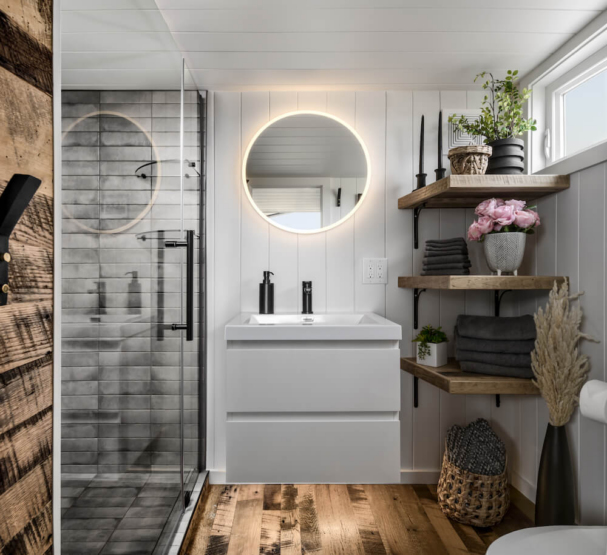
Have you ever wondered how some tiny house bathrooms feel twice as big as others without any extra square footage?
It’s never luck or expensive material, but proper structuring and a few well-placed decisions that make the real difference. Most people focus on what to add, but the smart move is to figure out what actually belongs in that space and where they must go.
To help you out, we are going to discuss some tips to maximize small bathroom space.
6 Design Ideas to Make a Functional Bathroom in Your Tiny Home
Here are six design ideas that actually deliver results:
- Start with Smart Layout
Before buying a single fixture, you must take a serious look at your bathroom layout. It’s an important step in designing a fully functional bathroom since everything else builds on it. If you get it wrong, it will waste space that will be hard to fix later.
In tiny homes, the three most popular layout options are:
- Wet bathroom layout treats the entire room as a shower zone, with no separation enclosure needed.
- Corner layout places the toilet and sinks on adjacent walls, which leaves the center open.
- Galley-style lines fixtures along a single wall are the best choice if you have narrow but long bathrooms.
You can pick any of these layout options that fits best according to your needs and bathroom space. You can also explore different small bathroom layout ideas on Pinterest and see how others have handled the same space constraints.
The image shows different bathroom layouts, including all necessary fixtures, a toilet area, and a shower.
One thing worth mentioning here is: some people wonder if separating wet and dry areas is the right call. But in a compact bathroom like under 35 sq ft or so, it’s not a good approach to follow. Separating dry and wet zones will require some extra space, and the bathroom will look smaller than it is.
- Compact Fixture Selection
In a small bathroom where every inch counts, avoid oversized toilets, deep-soaking bathtubs, or bulky sinks. Instead, try something that takes up less space and performs the function you need.
For instance, you can consider:
- Wall-mounted toilets that are fitted in the wall, covering less space than standard ones. They save around 9-12 inches of space, making your room feel more open and bigger.
- Corner sinks can be used in any dead area, making the most of your space and fitting perfectly in a tiny house bathroom.
- If you need both a bathtub and a shower in your small bathroom, then a shower-tub combo is a perfect fixture. Rather than installing both of them separately, which will require extra space, you can use the combo and save space to place other fixtures.
For better insight, check the image of how your small bathroom would look with compacted fixture.
In this image, you can see how different compacted fixtures all work together to make the space more open.
Ensure you only pick bathroom furniture that consumes less space. By chance, you can’t fit a normal-sized bathtub, you can use a soaking tub that takes up not much space. This way, you can make the most of the space without it feeling crowded or closed in.
- Make the Most of Your Wall Space
Instead of using horizontal space in the bathroom, consider the vertical or wall area. Because in a tiny room, you would already have a compacted space, so it is better to design your bathroom in a vertical space. This is also called the vertical space optimization.
Here are some design tips that can make the most of the wall space in your bathroom and save more floor area:
- Create floating wall shelves so you can store your essentials and avoid cluttering the bathroom.
- Attach hooks on the back of the door or with the wall to handle towels, robes, and bags without using any floor or counter space at all.
- Built overhead cabinets that won’t cover any floor space and can fulfill all of your storage needs.
This image shows how you can maximize storage with smart overhead cabinets and sleek floating shelves.
By using these design hacks, you will be able to develop a fully functional bathroom in a tiny house.
- Single Sink Vanity Choice
If you are considering a vanity for your tiny bathroom, size is the first thing to get right. A bathroom vanity that’s too wide throws off the entire layout and leaves no room to move.
A wall-mounted single sink bathroom vanity between 24 and 30 inches wide is the right fit for most tiny home bathrooms. They mount directly to the wall and keep the floor entirely clear underneath. This makes the room feel bigger and more open, so you can also clean it easily.
Another benefit of a bathroom vanity is that it comes with storage cabinets where you can put your daily-use items to keep the bathroom neat and clean.
The normal size of a single sink vanity for a tiny house bathroom should be:
- Width: 18 to 24 inches
- Depth: 14 to 18 inches
- Height: 30 to 36 inches
The image shows how a single sink vanity will cover less space in a small area with better storage options.
Remember, a vanity that sticks out too far cuts into the walking space, making moving around the bathroom awkward. Therefore, pick a bathroom vanity that is around 18 to 21 inches deep so that the room stays comfortable to navigate.
- Sliding Door for More Floor Space
Standard hinged doors are easy to install and cheaper, but they bring consistent problems in tiny bathrooms. The reason is that they need a clear arc of space to swing if it opens inside the restroom. In a tight room, that arc eats into usable floor area every single time the door moves.
So, you can consider installing sliding doors or pocket doors for this problem. Here’s how:
- Sliding doors mount on a track above the doorway and slide to one side. This makes it easier to add without wall modification and eliminates the swing arc problem entirely.
- Another option is pocket doors that tuck completely into the wall when open, making them invisible. This keeps the area open rather than divided into parts.
In this image, you can clearly see how a hinged door that opens inside the bathroom covers more floor space than a sliding door.
This one little change can free up enough room to make the bathroom noticeably more comfortable to move around in.
- Large Frameless Mirror Impact
A large mirror actually doesn’t add any space to your bathroom, but makes the brain think the room is bigger than it is. This is one of the oldest tricks in interior design, and it works just as well in tiny bathrooms as anywhere else.
So, when you place a mirror in your bathroom, make sure it is frameless, as it can easily blend into the wall, enhancing the perception of space.
This image demonstrates how a frameless full-width mirror reflects the room, making it appear larger than its actual size.
Another way to make your tiny home bathroom feel bigger is to use a full wall mirror, just like you see in public bathrooms. They give a complete reflection of the bathroom, making the area expansive and more open.
Final Thoughts
And with that, this article comes to an end!
Designing a functional bathroom in a tiny home is less about space and more about smart decisions. The right layout, compact fixtures, vertical storage, a properly sized vanity, a sliding door, and a well-placed mirror can completely change how the bathroom feels and functions. None of these requires a big budget. All you need is proper planning before doing anything.