

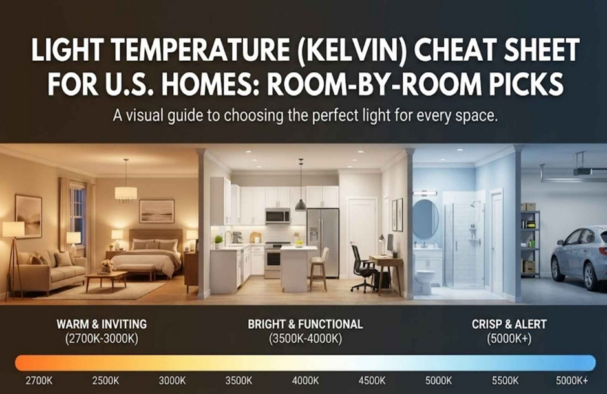
If your home ever feels “off” at night even after you changed fixtures, the problem may not be the chandelier or the lamp. It is often the light temperature. In the U.S., many households end up mixing random bulbs over time, which creates rooms that look yellow, blue, or mismatched from one space to the next.
This Kelvin cheat sheet is a practical, room-by-room guide to choosing light color that fits how Americans actually use their homes: winding down in the bedroom, cooking in the kitchen, getting ready in the bathroom, and welcoming guests at the entry.
Quick Kelvin Basics (Without the Science Lesson)
Kelvin (K) describes how warm or cool your white light looks:
- 2200K–2700K: very warm, candle-like to classic “soft white”
- 3000K: warm white, cleaner than 2700K but still cozy
- 3500K–4000K: neutral to cool white, crisp and task-friendly
- 5000K+: very cool “daylight” look, often too harsh for most living spaces at night
Your goal is not to pick one Kelvin for the entire house. Your goal is to choose a small, consistent set of Kelvins that makes each room feel right while still matching as you move through the home.
The Simple Rule That Prevents “Mismatched House Syndrome”
Here is a rule that fixes most homes quickly:
Use 2700K–3000K for living areas and bedrooms, then step up to 3000K–4000K only where you need sharper task light.
That creates a natural flow. Warm and relaxing in rooms where you hang out, slightly whiter in places where you shave, apply makeup, cook, clean, or handle detailed tasks.
Room-by-Room Kelvin Cheat Sheet
Living Room: 2700K–3000K
Living rooms are about comfort. Too cool a bulb can make sofas and skin tones look flat. Pick 2700K if you prefer cozy, or 3000K if you like a slightly cleaner look that still feels residential.
- Best for: lamps, chandeliers, ceiling lights, wall sconces
- Avoid: 4000K+ unless the living room doubles as a work zone all day
Bedroom: 2200K–2700K
Bedrooms benefit from warmer light because it supports a calmer nighttime routine. If you read in bed, keep reading lamps bright enough, but still warm.
- Best for: bedside lamps, soft ceiling fixtures, warm wall lights
- Pro tip: use dimmers so you can shift from “getting ready” to “winding down”
Kitchen: 3000K–4000K (Split by zone)
Kitchens are the classic room where one Kelvin often fails. A good approach is to split the kitchen into zones:
- Ceiling/ambient: 3000K keeps the kitchen connected to nearby dining and living spaces
- Task lighting (under-cabinet, prep zones): 3500K–4000K for clearer cutting, mixing, and cleaning
If your kitchen is open to the living room, staying closer to 3000K prevents the kitchen from looking “blue” compared to the rest of the home.
Dining Room: 2700K–3000K
Dining lighting should flatter food and people. Warm white is usually the safest bet. 2700K gives a classic dinner glow; 3000K reads slightly more modern.
- Best for: chandeliers, pendants, wall lights
- Must-have: dimmer switch for flexibility
Bathroom: 3000K–4000K (Depending on mirror quality)
Bathrooms are where people want accuracy. If your mirror lighting is too warm, makeup can look different outdoors. If it is too cool, it can feel clinical.
- Most homes: 3000K for a balanced, natural look
- Detailed grooming: 3500K–4000K, especially at the vanity
- Avoid: one bright 5000K bulb in a small bathroom, it can feel harsh fast
Home Office: 3000K–4000K
For screens and paperwork, neutral-to-cool light supports focus and reduces the “sleepy” feel that warm bulbs can create during the day. If the office is in a bedroom, lean closer to 3000K so it does not clash with warmer evening lighting.
- Best for: desk lamps, ceiling fixtures, task lights
- Tip: keep glare off monitors by placing lamps to the side, not behind the screen
Hallways and Stairways: 2700K–3000K (With gentle night options)
Hallways connect everything. Warm-to-warm-white keeps transitions comfortable and welcoming. If you use night lights, choose very low output warm tones so they do not wake you up.
Entry/Foyer: 2700K–3000K
The entry is your home’s first impression. Warm white looks welcoming and works well with most wall colors. If your foyer is large or two-story, 3000K can help it feel clear and open without going cool.
Laundry and Utility Spaces: 3500K–4000K
These are task zones. Cooler, crisper light helps you see stains, sort colors, and clean effectively.
Garage and Workshop: 4000K (Sometimes higher)
For projects and storage, clarity matters more than coziness. Many homeowners prefer 4000K in garages. If you do detailed work, you may go higher, but it can look stark compared to interior rooms.
Choosing Kelvin Is Not Enough: Two Quick Checks
1) Stick to one Kelvin per “line of sight”
If you can see your kitchen from the living room, and the living room is 2700K while the kitchen is 5000K, it will look mismatched immediately. In open-concept layouts, keep adjacent spaces within one “step” of each other (for example 2700K next to 3000K, or 3000K next to 3500K).
2) Use dimmers to make one Kelvin work harder
A dimmer helps you keep the same Kelvin but change the mood. This is especially useful in dining rooms, bedrooms, and living rooms.
A Fast Weekend Plan to Fix Your Whole House
- Pick your core warm Kelvin: 2700K or 3000K for living areas.
- Pick your task Kelvin: 3500K or 4000K for work zones (kitchen task, bath vanity, laundry).
- Replace the most visible bulbs first: entry, living room, kitchen ceiling, main hallway.
- Then standardize lamps and secondary fixtures room by room.
This approach avoids buying the wrong bulbs twice and immediately makes your home feel more consistent at night.
Want a Cohesive Look Across Fixtures and Rooms?
Once your Kelvin plan is clear, choosing fixtures becomes easier because you know how you want the home to feel in each space. If you are browsing options for chandeliers, pendants, ceiling lights and wall fixtures that can coordinate across multiple rooms, you can explore Seus Lighting for complete home lighting. A consistent Kelvin strategy paired with cohesive fixtures is one of the fastest ways to make a house feel more finished and intentional.