Florida’s population grew 1.9 percent in 2024—its fastest pace since 1957, according to the U.S. Census Bureau report. Meanwhile, the median single-family home runs about $410,000, and average rent sits near $2,350 a month. Faced with those numbers, retirees, remote workers, and first-time buyers are turning to small-home communities—clusters of cottages under 400 sq ft. After Florida adopted Appendix Q and many counties eased minimum-size rules, builders began converting RV parks and ranchland into pocket neighborhoods. Today, more than a dozen legal communities dot the state, and this guide will help you choose the one that fits your life and budget.
How To Begin Your Search: Zeroing In On The Right Community
Florida lists at least 11 legal tiny-home communities as of November 2025. Visiting them all would take more than a weekend, so a quick filtering system saves windshield time.
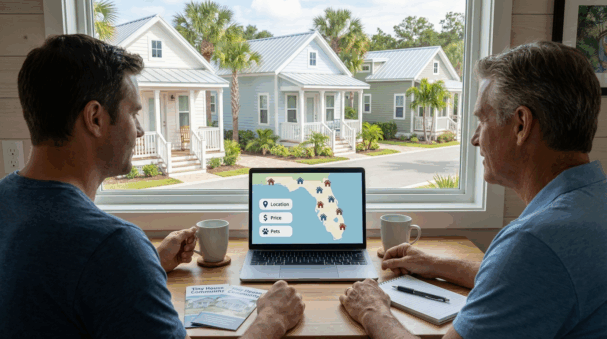
- Start online. Plug location, price cap, and pet policy into the Florida tiny-community directory. The county map shows lot-rent ranges at a glance and flags parks that allow bring-your-own certified homes, trimming a hundred options to a handful.
- Reach out. Email or message each manager for current lot fees, HOA rules, and wait-list length. How fast they reply, and how clearly, tells you as much as any brochure.
- Walk the grounds. Book a day tour or, better, a weekend in a rental model. Two nights in a 280-square-foot cottage reveal noise levels, storage quirks, cell-service dead zones, and summer A/C performance better than any website can.
- Stack the facts. Compare finalists side by side on total monthly cost, commute time, and amenities. Most buyers spot their winner the moment the numbers line up.
Florida Small-Home Communities By Region
Florida’s tiny-living map falls into five distinct zones: the Panhandle, Central Florida, the Gulf Coast, the Atlantic/Space Coast, and the Keys. Each area offers its own blend of cost, climate, and zoning rules. Review the summary here, then explore the detailed profiles that follow.
Panhandle & North Florida: Emerging Tiny-Home Scene
Cross I-10 and the landscape changes: pine forests replace palms, and rural land costs 25 %–30 % less per acre than the state median. Planners from Pensacola to Tallahassee are testing smaller footprints.
Pensacola – Phoenix Project. Non-profit AMR plans 14 pocket neighborhoods of about 12 homes each, totaling 168 units, on scattered infill lots across Escambia County. The pilot site, Fresh Start Village, framed its first seven cottages in 2024 and serves youth aging out of foster care.
Tallahassee – The Dwellings. On 24 wooded acres west of town, this supportive village finished its 130th unit in 2019 and now houses about 80 adults with on-site case management. Local officials cite the project as proof that sub-500-sq-ft dwellings can meet code and change lives.
Milton – Sunny Shores. This low-key park outside Pensacola lists roomy pads for about $400 a month and offers a pool, toolshed, and weekend fish-fries under the oaks. The setting shows that private options extend beyond headline projects.
Zoning in the Panhandle remains uneven, so confirm county rules before towing in a trailer. Even so, falling land costs, city-backed pilots, and success stories like The Dwellings point to steady growth for North Florida’s tiny-home market. For on-the-ground help, a Florida real-estate brokerage like SquareFoot Homes helps buyers sanity-check county allowances for sub-400-sq-ft homes and get current lot-rent ranges before they tour.
Central Florida: Orlando Energy, Ocala Ease, And Lake-Country Calm
Rolling pastures and spring-fed lakes make Central Florida the state’s tiny-home hub. Land sits on higher ground, lot rents stay moderate, and counties such as Orange, Marion, and Lake already welcome houses under 400 sq ft.
Orlando – Orlando Lakefront at College Park. This revitalized 1950s RV park hosts 50 legal tiny-home pads on Lake Fairview. Lot leases range from $350–$650 a month, roughly half the city’s median apartment rent. Spaces fill fast because residents enjoy lake access and a seven-minute drive to downtown.
Ocala – Simple Life cottages. West of town in horse country, Simple Life offers cottages under 400 sq ft with a saltwater pool, fitness studio, and dog park. Homes start at about $125,000, and lot fees average $350–$450 a month, covering water, cable, trash, and landscaping.
Lake Okeechobee – Gracious Tiny House Park. This 1.5-acre enclave on the Rim Canal leases 21 lots, including 10 waterfront sites, for $375 a month with utilities and Wi-Fi included. Evenings feature potlucks and pontoon rides, proving lake life matches a leaner’s footprint.
These communities share three advantages: inland elevation that dodges coastal surges, zoning friendly to both wheels and foundations, and housing costs within reach for teachers, tech pros, and retirees. For variety, legality, and year-round breezes without beach-front premiums, Central Florida is the sweet spot.
Gulf Coast: From Tech-Savvy Tampa To Eco-Chic Sarasota
Florida’s west rim blends salt air with startup energy, and three tiny-home hot spots highlight the mix.
Tampa – Escape Tampa Bay: The Oaks. On three shaded acres, this village tucks more than 40 wood-clad cottages (all under 400 sq ft) beneath century oaks. New units start near $100,000, and the $625 monthly lot fee covers parking and all utilities, keeping housing well below the $2,280 median Tampa rent. The math attracts tech workers who would rather build equity than sign another apartment lease.
Ruskin – Circle Pond Tiny Community. On 4.5 leafy acres, 12 pads ring a spring-fed pond. Lots rent for about $600 a month, including water, sewer, garbage, lawn care, and electricity. Each resident receives a raised garden bed, and solar panels or rain barrels earn recognition from the owner, who won a 2019 Sustainable Business Award.
Sarasota – Tiny House Siesta. Five minutes from Siesta Key Beach, this resort lines up a dozen colorful rentals. Nightly rates sit around $160–$250 during peak season, letting guests test-drive micro living before buying.
Hurricane risk is higher in the Gulf. Communities require impact glass, tie-downs, and elevated foundations. Insurance costs more than inland, yet even with premiums, total expenses stay far below coastal condos. Add Gulf sunsets, and it is clear why the west coast serves as Florida’s imaginative proving ground for small-home living.
Atlantic & Space Coast: Rockets, Reefs, And Room To Innovate
Skirt Cape Canaveral and you reach the shoreline where NASA launches and tiny-home projects share the same sky.
Cocoa – Peace Wind at Braveheart Properties. Developer Jinkie Echols drafted Brevard County’s first tiny-home zoning code, then carved 84 sites on 35 acres for a mix of houses on wheels and 400-sq-ft cottages. Residents tend gardens, fish from a communal dock, and watch night launches arc over the Indian River.
Jensen Beach – Ocean Breeze Resort. This 55-plus marina park slots park-model tiny homes along the Intracoastal Waterway. Lot rent runs $770–$790 a month, covering water, sewer, trash, and lawn care. The fee is a bargain compared with coastal condos that often top $3,000 in HOA charges alone.
Zoning east of I-95 remains strict, so most projects sit a few miles inland, where land is cheaper and elevation safer. Builders meet hurricane codes with impact glass, tie-downs, and metal roofs, while salty air demands stainless fasteners and cement-board siding. Up-front costs are higher than inland, yet mortgages still trail oceanfront condos, and sunrise walks to the Atlantic come standard.
Florida Keys: Tiny Living In Paradise, With Caveats
Cross the Seven Mile Bridge, and turquoise flats meet pastel sunsets. A 300-sq-ft cottage sounds dreamy, and Sunshine Key Tiny House Village on Ohio Key lets you test it for $250–$300 a night. Pelicans glide at dawn, and kayaks launch from the front steps. It is vacation magic, not ownership, but it proves pocket living works where the Gulf meets the Atlantic.
Permanent roots are tougher to set. Monroe County’s Rate of Growth Ordinance (ROGO) limits new housing to about 900 permits Keys-wide through 2027. Vacant lots sell for six figures, each home must withstand 180-mph wind loads and sit above FEMA flood lines, and insurance can double mainland rates.
Developers who clear the hurdles place cottage-size units in legacy RV parks near Marathon or Key Largo. Buyers purchase the home but lease the lot, with prices starting near $225,000 plus $1,000 or more in monthly rent. Many shoppers choose a seasonal plan: tow a certified THOW south for winter and return inland before hurricane season peaks.
Design choices here are non-negotiable: stainless fasteners, metal roofs, impact glass, and stilts tall enough to shelter paddleboards during king-tide season. The payoff is morning coffee on a wraparound deck, mangrove breezes, and utility bills that feel tiny next to Key West condos. For those willing to juggle regulation, risk, and price, a Keys-size home delivers a lifestyle no mainland ZIP code can match.
Florida Tiny-Home Laws, Zoning, And Codes: Read These Rules Before You Roll In
A tiny house may be small, but its rulebook isn’t. The good news: in January 2020, Florida adopted Appendix Q of the state building code, a chapter written for homes under 400 sq ft. It lists loft height, stair width, and egress sizes, giving plan reviewers a checklist instead of a shrug. That single change flipped many projects from “maybe” to “yes.”
Zoning, however, remains local. Orange and Sarasota counties allow a 170-sq-ft cottage on a residential lot, while parts of the Panhandle still require 1,000-sq-ft minimums. Always pull the land-use code for the exact parcel you want; one sentence can separate dream from denial.
If your home rolls, add another layer. A tiny house on wheels (THOW) is legally an RV, so full-time living is allowed only in RV-zoned areas or in communities that won exemptions. A foundation-built tiny house must meet the same wind-load and flood-elevation rules, up to 180 mph in coastal zones, as any bungalow.
Bottom line: Appendix Q explains the how. Local zoning dictates the where. Nail both, and the rest is logistics, not legislation.

Designing A Tiny Home That Thrives In Florida’s Heat, Humidity, And Hurricanes
Small square footage does not excuse skimpy engineering, especially in a state known for 95 °F afternoons and 150-mph wind zones.
Tame the heat. Choose an ENERGY STAR mini-split rated SEER 22 or higher; Department of Energy tests show that inverter units can cut cooling costs by up to 30 percent in humid climates. Wrap walls and roof with 2–3 inches of closed-cell spray foam (≈ R-14), then staple a radiant barrier under the metal roof. Vent lofts with an operable window or an 80 CFM attic fan to allow trapped air to escape.
Beat back moisture. Florida air often holds more than 70 percent relative humidity. Flash window openings, tape every sheathing seam, and run a bath fan on a 20-minute timer after showers. A 30-pint dehumidifier tucked under the stair landing removes the rest.
Anchor for storms. The Florida Building Code requires coastal structures to resist up to 180 mph design wind speed. Sink hurricane straps into concrete piers or use FEMA-rated ground anchors for THOWs. Install large-missile impact windows or quick-latch shutters that close in ten minutes. Keep the roof at a 3-in-12 pitch or steeper, so rain sheds fast, and secure panels with screws instead of nails.
Pick coastal-tough materials. Swap pine siding for fiber-cement or engineered wood that shrugs off termites and salt spray. Stainless fasteners prevent rust streaks, and composite decking saves annual re-staining weekends. For layout inspiration that already nods to Florida’s climate and code realities, browse this curated set of Florida house plans; many concepts adapt cleanly to tiny or small-cottage footprints.
Expand outdoors. A 6-foot screened porch effectively doubles living space nine months each year; you are not paying to cool it, yet it turns mosquito hour into cocktail hour.
Built to these specs, and your 280-sq-ft cottage will stay cool, dry, and hurricane-ready for whatever Florida throws at it.
DIY or Turnkey: Choosing Your Path To Tiny-Home Ownership
Some of us enjoy sawdust and sketchbooks, while others want the keys next Friday. Florida’s tiny-home market supports both plans.
Build it yourself. Communities such as Orlando Lakefront and Braveheart welcome certified THOWs. A simple DIY build in Florida averages $40,000–$60,000 in materials and systems, plus $2–$4 per mile to tow it to your site. Sweat equity trims costs, and you control every finish, but you will spend evenings sourcing hurricane straps and adjusting loft stairs.
Buy move-in ready. At Escape Tampa Bay, finished cottages under 400 sq ft start near $100,000, and the community’s $595 monthly lot fee covers water, sewer, trash, and landscaping. Financing is streamlined, permits are handled, and your first decision is where the couch goes.
Choose the route that fits your skills, timeline, and paperwork tolerance. Either way, a Florida tiny-home community can have a pad ready when your front door is built.
The Trade-Offs: Florida Tiny-Community Life, Pros And Cons
Living small in a purpose-built village offers perks most subdivisions cannot match. Up-front housing costs drop, zoning headaches disappear, and neighbors share the less-is-more mindset. Morning walks often lead to impromptu coffee chats, and community gardens thrive because someone is always around to water the basil.
Every advantage carries a cost. Lot rent, typically $300–$800 a month in Florida, rises with inflation, so budget for annual increases spelled out in the lease. Community rules keep paint colors consistent but also set limits on pets and porch décor. Storage is scarce, so that kayak or holiday trim may need an off-site locker at $50–$100 a month in many counties.
In short, tiny communities trade square footage for freedom and absolute independence for shared standards. Step in with clear eyes, and the equation favors livability; skip the fine print, and a bargain cottage can feel tight once the novelty fades.
Conclusion
Florida’s tiny-home movement proves you don’t need big square footage to build a big life. Whether you choose a pine-lined pad in the Panhandle, a lakefront perch near Orlando, or a hurricane-ready cottage on the Gulf, the state offers legal, well-planned communities for every budget and lifestyle. The key is doing your homework—touring sites, comparing true monthly costs, and confirming zoning before you commit. When the numbers, rules, and rhythm of daily life align, a 300-square-foot home feels less like a compromise and more like a reset. For many Floridians, tiny living isn’t a trend; it’s a smarter way forward.