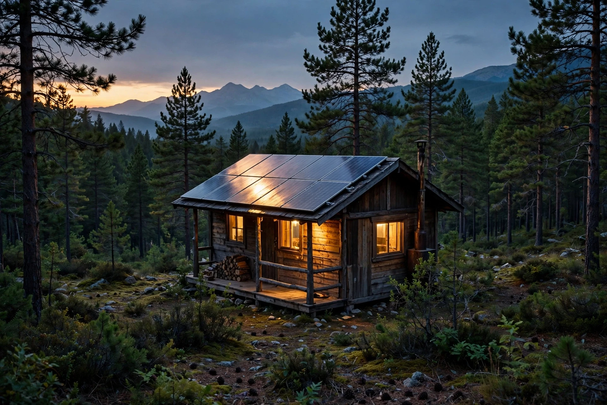
For an efficient off-grid cabin using about 2 kWh per day, the right bank of solar storage batteries is about 6 kWh of lithium iron phosphate (LFP) or 12 kWh of flooded lead-acid, sized for three days of autonomy.
Getting the bank wrong leaves the cabin dark on the second cloudy day; getting it right gives a decade of quiet, trouble-free service. A1 SolarStore, which has supplied solar equipment since 2017, explains below how flooded lead-acid, AGM and lithium iron phosphate (LFP) batteries differ in usable capacity, cycle life and upkeep.
Sizing starts with a list of loads and comes down to depth of discharge. The sections below work through that math, compare flooded lead-acid, AGM and LFP, and show how placement and replacement cycles affect a bank over time.
How Much Storage Does a Cabin Actually Need?
Do not try to find the answer in the floor plan: it gives the size of the house and how many people live there, not the load. The US Energy Information Administration estimates that the average American family consumed 30 kWh per day in 2022, and a cabin will likely consume far less. The question is how much less.
Here is how to calculate a sample cabin: build a list of every device, multiply its power in watts by its hours of operation, then add the results together to get the total kilowatt-hours per day (kWh). That total is the starting size for the battery bank.
- LED lights: 40 watts x 5 hours = 200 watt-hours
- Efficient 12V fridge: about 50 watts averaged over 24 hours = 1,200 watt-hours
- Laptop and phones: 60 watts x 4 hours = 240 watt-hours
- Water pump, fan, and small TV: roughly 400 watt-hours
The sample cabin uses about 2 kWh per day, though individual needs vary. A cabin with electric heating or air conditioning will come in several times higher than this sample.
Days of Autonomy
Days of autonomy is a measure of how many sunless days a battery bank can supply power without solar input from the array. Two to three days is a good target for a cabin PV system.
Do not size the battery bank for the average day of sunshine; size it for the dark month. A bank sized on average sunshine will leave the cabin in darkness during December.
The Sizing Math for a 2 kWh Cabin
The math is straightforward once daily consumption and days of autonomy are known: (daily consumption × days of autonomy) ÷ depth of discharge.
- Lithium iron phosphate (LFP) at 100 percent depth of discharge, per Battle Born’s spec sheet for its 100Ah 12V battery: (2 × 3) ÷ 1.00 = 6 kWh of rated storage, or five 100Ah 12V batteries.
- Flooded lead-acid at the recommended 50 percent depth of discharge, per Trojan’s spec guide: (2 × 3) ÷ 0.50 = 12 kWh of rated storage, or nine 6V 225Ah batteries.
Same system, twice the battery bank. Depth of discharge has a direct impact on the final number, and it cannot be ignored.
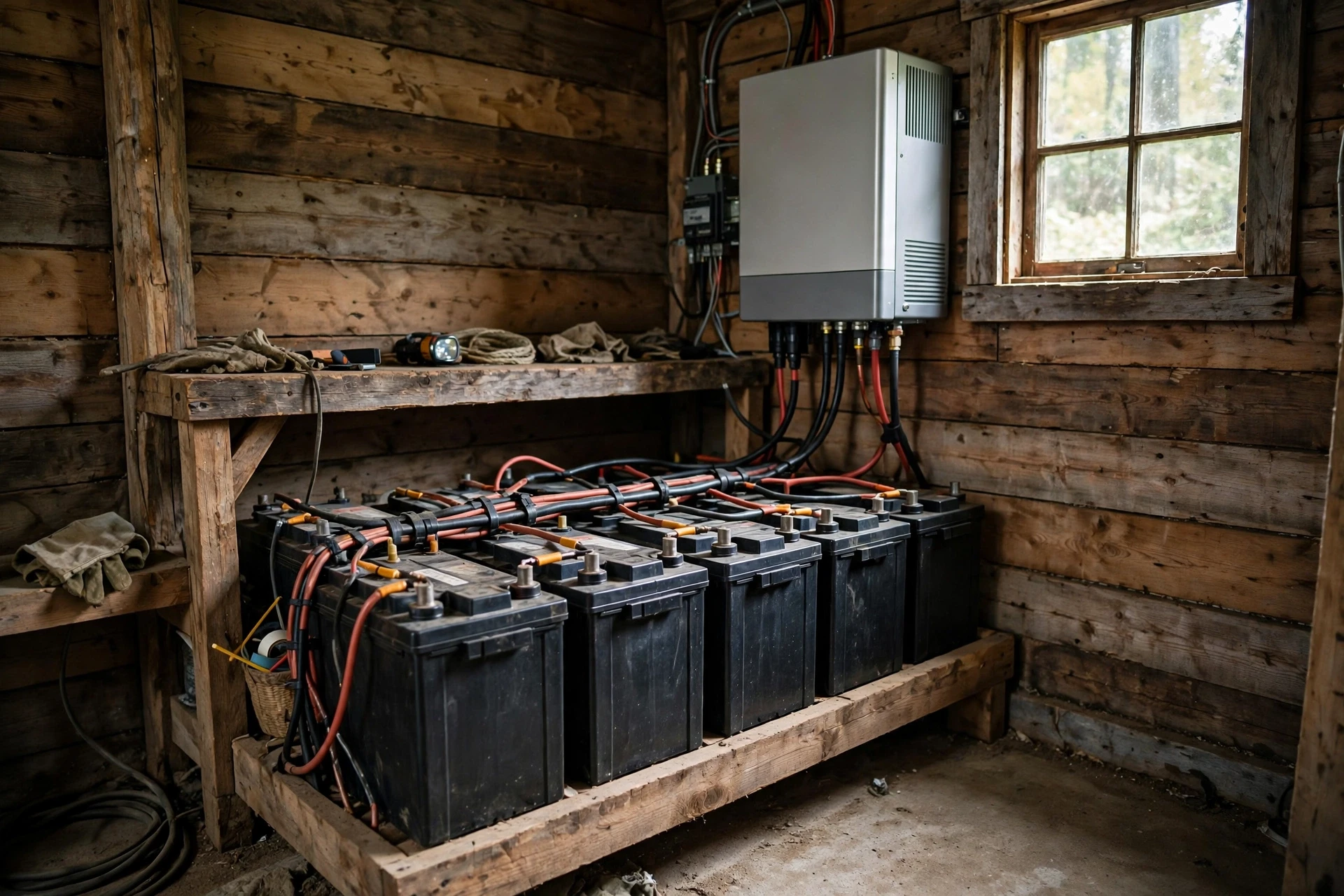
Choosing a Battery Chemistry for a Cabin
There are three battery chemistries that cover most residential and commercial cabin applications. All are deep cycle batteries designed to be discharged and recharged daily. Which chemistry to choose depends on a cabin’s intended use, which is what this article explores.
Flooded Lead-Acid: When It Makes Sense
Flooded lead-acid batteries are the oldest rechargeable chemistry still in common solar use, and for good reason. Trojan T-105 batteries, in the company’s Signature Line of deep-cycle flooded batteries, are rated at 1,200 cycles at 50 percent depth of discharge, according to the company’s specifications. A single T-105 weighs 62 pounds and provides 225 amp hours at 6 volts. The chemistry does come with upkeep:
- Regular watering with distilled water, because the cells are flooded rather than sealed
- A well-ventilated mounting area, to expel the hydrogen gas that forms during charging
Flooded batteries are best suited for banks that see little use or are not used for extended periods of time, such as a weekend cabin that might only see use twice a year.
AGM: The Sealed, Maintenance-Free Option
AGM batteries use absorbent glass mat in a sealed lead-acid battery. AGM batteries do not require watering or venting. An absorbed glass mat battery can be charged in freezing temperatures, while standard lithium batteries cannot.
Trojan’s AES AGM line has up to 1,200 cycles at 100 percent depth of discharge and a 3-year warranty, illustrating that sealed lead-acid batteries have come a long way.
Lithium Iron Phosphate (LFP): The Standard for Daily Cycling
For daily cycling, the lithium chemistry to consider is lithium iron phosphate (LFP). Battle Born’s 100Ah 12V battery publishes the figures that make the chemistry the default for cabins that cycle every day:
- Cycle life: 3,000 to 5,000 cycles
- Depth of discharge: 100 percent
- Round-trip efficiency: 99 percent
- Warranty: 10 years
- Built-in battery management system
- Weight: 31 pounds for the 100 amp-hour battery
The chemistry cannot be charged at freezing temperatures. Heated models address that limit with a built-in heater that turns on near 35 degrees Fahrenheit to warm the cells before charging begins.
| Model | Chemistry | Rated Capacity | Usable Depth of Discharge | Rated Cycle Life | Weight |
| Trojan T-105 | Flooded lead-acid | 6V, 225Ah (1.35 kWh) | 50% | 1,200 cycles | 62 pounds |
| Trojan T105-AES | AGM | 6V, 207Ah (1.24 kWh) | 100% | 1,200 cycles | 68 pounds |
| Battle Born BB10012 | Lithium iron phosphate (LFP) | 12V, 100Ah (1.28 kWh) | 100% | 3,000 to 5,000 cycles | 31 pounds |
Spec-Sheet Numbers: What They Actually Mean
The big number on a battery spec sheet is kilowatt-hours, but it doesn’t tell you how much power a cabin will really get. Four other specs do.
Usable Capacity
Usable capacity is nameplate capacity times depth of discharge. So, a 1.35 kWh flooded battery at 50 percent depth of discharge only delivers 0.68 kWh of useful storage.
By contrast, a 1.28 kWh lithium battery at 100 percent depth of discharge delivers all of its capacity. Do not size batteries based on nameplate capacity, but based on what they can actually store.
Cycle Life and Expected Years of Service
Cycle life is the number of full discharge-charge cycles a battery bank can endure before its capacity drops below 80 percent of nameplate.
At one cycle per day, Trojan’s 1,200-cycle flooded battery bank lasts about 3 years. Battle Born’s lithium battery bank, at 3,000 to 5,000 cycles, lasts 8 to 13 years. Properly sized banks last longer.
Why Does Round-Trip Efficiency Matter?
Efficiency, specifically round-trip efficiency, equals the percentage of stored energy available for use.
Battle Born rates its batteries at 99 percent, meaning almost none of the energy is lost or wasted during the charge and discharge process. Lead-acid batteries are not as efficient, losing more energy as heat during charging, energy the solar panels then have to replace during the daily charge.
Temperature and Charging Limits
Most lithium batteries cannot be charged at temperatures below freezing, so the charge process warms the battery until its internal temperature reaches 35 F.
Discharging lithium batteries in the cold is fine, but charging them is not. Lead-acid batteries can be charged at subfreezing temperatures, which is why AGM batteries still have a place in northern climates where buildings are not heated. Even so, no battery bank should be left outside in the cold; an insulated box in a conditioned building is best.
Battery Bank Placement in a Cabin
Place the off-grid solar battery bank in a ventilated utility room, a heated shed, or an insulated enclosure, and keep the runs to the loads short to conserve power and reduce cable size. Long DC runs are inefficient and require large-diameter, costly wiring.
- Weight: fifteen Trojan T-105s for a 20 kWh flooded battery bank weigh more than 900 pounds, while lithium batteries typically weigh about half as much, so confirm the floor can handle the load before stacking batteries.
- Ventilation and access: flooded batteries need proper ventilation and must sit upright, with access to the caps for watering.
Lifetime Cost and Replacement Cycles
Solar plus storage is no longer a niche. According to the Lawrence Berkeley National Laboratory’s data, batteries are being added to 37% of new residential solar PV systems in the U.S. in 2025 (vs 25% in 2024), and the median battery size is 13.5 kWh.
Counted in replacements rather than dollar amounts, the lifetime picture looks like this:
- Flooded bank at 1,200 cycles, cycled once a day: replaced about every 3 years, or three sets over a 10-year period
- Lithium bank at 3,000 to 5,000 cycles: one set lasts 8 to 13 years
That count still excludes the additional flooded capacity needed to offset lithium’s deeper discharge.
Replacement Frequency by Chemistry
Lithium retains nearly all of its capacity over thousands of cycles. Flooded batteries maintain about half, and you will replace them several times over the life of the battery.
For a battery that is cycled every day, the choice is clearly lithium. For a seldom used backup battery, the simple flooded chemistry wins.
Matching the Bank to the Cabin
Cabin banks are matched to measured loads, not to roof space or budget alone. The three chemistries covered in this article, flooded lead-acid, AGM, and lithium iron phosphate (LFP), fit different cabins, flooded suits the lowest upfront cost with regular upkeep, AGM suits a sealed indoor space, and LFP suits daily cycling over a long service life. Trojan deep-cycle models are among the lines commonly installed in off-grid cabins.
The system that works best in an off-grid application is the one sized appropriately to measured loads, so spec the battery bank from the loads the cabin or home will actually run. A1 SolarStore has supplied solar equipment since 2017, and its published range covers the flooded lead-acid, AGM, and lithium iron phosphate (LFP) batteries discussed in this article.
FAQ
How many solar batteries does a cabin need?
Divide daily kilowatt-hours by battery voltage to find amp-hours, then divide by the usable depth of discharge. For the 2 kWh sample cabin, that works out to approximately five 12 volt 100 amp hour lithium batteries or nine 6 volt 225 amp hour flooded batteries to last three days.
How long do solar storage batteries last?
It is about cycle life. Lithium batteries rated for 3,000 to 5,000 cycles will last about 8 to 13 years with only one cycle per day, whereas a flooded battery rated for 1,200 cycles will only last 3 years. Calendar aging is independent of cycle life. So, even a seldom used battery will age.
What is depth of discharge?
It’s a percentage of the battery’s capacity that you can use before needing to recharge. It defines how much of the nameplate rating is applied to your cabin: 50 percent for the flooded batteries in the table above, 100 percent for the lithium and advanced AGM batteries.
Can lithium batteries charge below freezing?
Standard lithium batteries cannot, as their battery management systems prevent charging near freezing to avoid permanent damage. Heated batteries warm up the cells first. As a result, in an unheated environment exposed to extreme cold, AGM batteries are a better option than lithium batteries.
Is lithium worth it for a weekend cabin?
It depends on the frequency of cycling. If you have a cabin that you use every weekend, then you’re going to see the value proposition of lithium. But if you’re using a cabin twice a year, it’s probably not worth the trouble. That’s where a lead-acid battery makes sense.