Whether you are building a backyard workshop from scratch or maintaining a hillside home in Western Pennsylvania, your concrete slab takes a relentless beating every winter. If you commute along the Parkway or navigate slushy neighborhood hills, your tires inevitably drag snow, grit, and heavy PennDOT road salt straight inside. Over just a few seasons, that salty meltwater seeps into bare concrete, leaving behind chalky white efflorescence, stubborn oil stains, and crumbling, pitted surfaces.
For DIY builders who have put time and sweat into pouring a solid foundation using tiny house plans or detached garage blueprints, watching that fresh slab deteriorate is frustrating. Because standard roll-on hardware store paints rarely survive a single Pittsburgh winter without peeling, more homeowners and builders are turning to professional garage floor coatings in Pittsburgh to permanently seal and reinforce their floors. Understanding how a freeze-thaw climate attacks concrete—and how to properly prep a slab—will help you protect your workspace for decades.
Why Western Pennsylvania Winters Destroy Bare Concrete
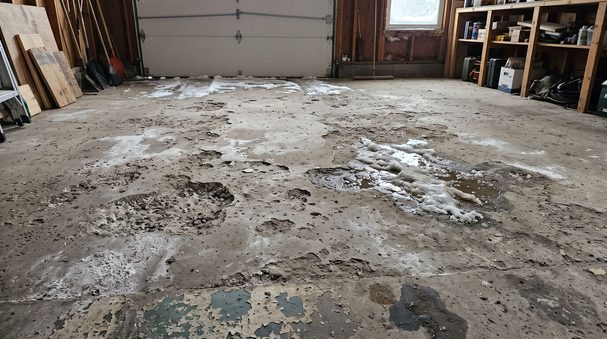
A common misconception among DIYers is that extreme, sub-zero cold is what ruins concrete. In reality, a winter that stays frozen solid from December through March is far kinder to a concrete floor than Pittsburgh’s signature wet, fluctuating winters. Temperatures across Allegheny County routinely swing above freezing during the afternoon and plunge back below 32°F overnight.
Every time temperatures cross that freezing mark, a destructive chain reaction happens inside an unsealed slab:
- Internal Expansion Pressure: Bare concrete is naturally porous. When snowmelt drips off your vehicle or snowblower and soaks into those microscopic pores, it freezes overnight and expands by roughly 9%. That internal pressure fractures the top paste of the slab from the inside out.
- The Road Salt Multiplier: De-icing salt and liquid brine do not just corrode concrete chemically—they also lower the freezing point of water. That means salty puddles sitting on your floor cycle between liquid and ice far more frequently than plain rainwater, accelerating pitting and surface flaking (spalling).
- Ground & Foundation Moisture: Many Pittsburgh homes built into hillsides feature integral, below-grade garages, while backyard structures built from shed plans often sit directly on frost-prone soil. Groundwater and clay-rich earth push moisture vapor upward through the slab, weakening surface concrete and causing cheap paints to blister and peel.
Once spalling begins, the exposed aggregate traps even more water, turning minor surface flaking into deep craters that require expensive structural patching.
Why Mechanical Surface Prep Matters More Than the Coating Itself
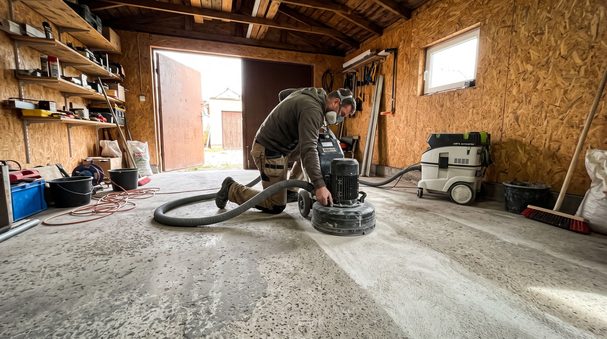
If you follow DIY building guides, you already know that proper prep work makes or breaks any construction project. Concrete coatings are no exception. Even the most advanced polyaspartic resin on the market will fail if applied over a dirty, damp, or overly smooth slab.
In professional concrete resurfacing, surface preparation is the single biggest predictor of whether your floor still looks showroom-new fifteen years from now. A disciplined installation follows a five-step protocol:
- Slab Moisture Testing: Before grinding begins, the concrete must be tested for excess moisture vapor emission (using standards such as ASTM F1869 or ASTM F2170), which is the leading cause of coating adhesion failure.
- Industrial Diamond Grinding: Acid etching cannot reliably open concrete pores or remove deep oil saturation. Heavy planetary grinders hooked to HEPA dust extractors mechanically profile the slab to the exact Concrete Surface Profile (CSP) required by ICRI Guideline 310.2R.
- Crack and Spall Restoration: Hairline cracks, pitted salt pockets, and chipped apron edges are chased, vacuumed, and filled with rapid-curing polyurea mender, then ground completely flush.
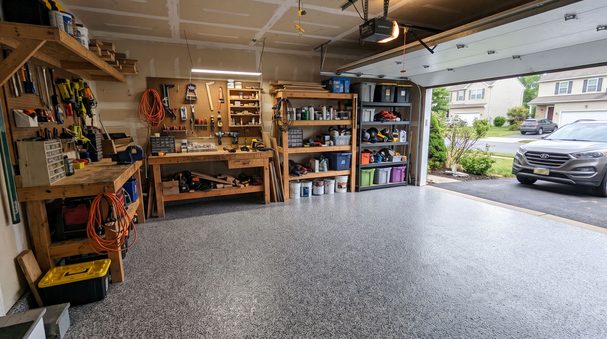
- Base Coat and Full-Flake Broadcast: A thick, pigmented base coat is rolled out, followed by broadcasting decorative vinyl chips “to refusal” across 100% of the surface. Full-flake coverage adds mil thickness, hides minor slab imperfections, and creates built-in slip resistance when wet.
- Scrape, Vacuum, and Polyaspartic Topcoat: Once cured, loose flakes are scraped smooth and vacuumed away. A crystal-clear, high-solids polyaspartic topcoat locks the entire system together into a seamless, non-porous barrier.
Practical Maintenance Tips for Coated Garages & Workshops
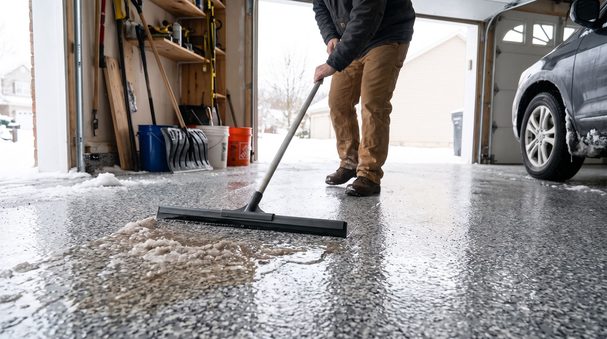
One of the biggest perks of upgrading your concrete floor—especially if you use your garage for woodworking, mechanics, or project builds—is how effortless it is to sweep and clean compared to dusty, porous cement. A few simple habits will keep the finish looking sharp through decades of harsh winters:
- Squeegee Winter Slush Periodically: While polyaspartic coatings are impervious to road salt, letting deep puddles of dirty slush dry on the floor leaves behind a chalky film of dried salt crystals. A quick pass with a foam floor squeegee every couple of weeks keeps the space spotless.
- Use Mild, pH-Neutral Cleaners: For deeper spring cleanings, skip harsh citrus degreasers or acidic washes, which can dull the clear coat over time. Warm water mixed with a few ounces of mild ammonia or a pH-neutral floor cleaner—applied with a soft microfiber mop—is all you need.
- Watch Out for Metal Edges: Dragging heavy steel snowblower skids, metal-edged snow shovels, or floor jacks with seized metal wheels across any resinous floor can scratch the topcoat. Opt for poly-edged shovels and place rubber pads under jack stands or heavy shop equipment.
4 Questions to Ask Before Hiring a Local Installer
If you decide to hire a local pro rather than tackling a coating system yourself, remember that a freshly coated floor looks glossy on day one regardless of how it was prepped underneath. Asking the right questions during your estimate protects your investment:
- Do you diamond-grind every floor, or do you acid-etch? Any contractor still relying on acid washing or pressure washing for concrete prep is cutting a fatal corner.
- Is moisture testing included before installation? This is non-negotiable for older Pittsburgh homes, hillside integral garages, and detached outbuildings.
- Are you quoting a full-flake broadcast or a partial “sprinkle”? Partial broadcasts use less material and look thinner, offering less slip resistance and impact protection against dropped tools.
- What does your warranty actually cover? Look for clear, written terms covering peeling, blistering, and delamination—and verify whether the warranty is backed by both the installer and the material manufacturer.
Whether it serves as your main daily entrance or your weekend workshop, your concrete slab is the foundation of your space. Sealing it with a diamond-ground, UV-stable polyaspartic system stops winter freeze-thaw spalling in its tracks, eliminates concrete dust, and turns a stained utility floor into a clean, durable part of your home.