Glendale bakes in sunshine—about 285 bright days and only 21 inches of rain each year. That heat can turn an uncovered patio into a furnace and spike your A/C bill.
A smart shade cover flips that glare into livable square footage and trims cooling costs. Yet with almost 200,000 locals and ad-heavy search pages, finding a reliable Glendale patio-cover installer is tough.
So we dug into licenses, reviews, warranties, pricing, and permit chops to pinpoint the 12 top Glendale patio-cover contractors. Skim the list, pick your pro, and enjoy breezy shade the next time the Valley pops past 100 °F.
How we ranked Glendale’s patio-cover pros
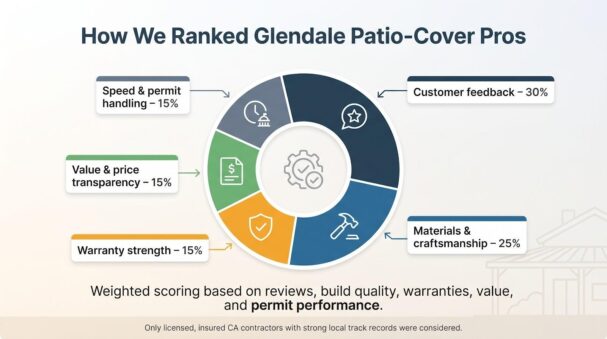
We wanted a scoring model we’d trust on our own patios, so we set two hard entry gates: an active California contractor license and either at least 50 public reviews or 10 + years building patio covers in Glendale. Any firm that missed a gate was out.
Each remaining contractor earned a composite score from five weighted factors:
- Customer feedback – 30 percent
Volume and average ratings on Google, Yelp, and Angi. - Materials and craftsmanship – 25 percent
Gauge of aluminum, UV-stable vinyl blends, joinery details, and factory-finish warranties. - Warranty strength – 15 percent
Length and clarity of written coverage plus documented service history. - Value and price transparency – 15 percent
Published square-foot pricing, clear change-order terms, and financing details. - Speed and permit handling – 15 percent
Skill at steering Glendale’s two-week plan check and typical HOA reviews without red-lines.
Higher composite scores floated to the top, giving you a defensible, repeatable ranking, not a popularity contest.
At a glance: compare Glendale patio-cover leaders
Need the short list first? The grid below lets you spot two or three contractors that fit your budget and style.
| Contractor | Core material focus | Years in business | Typical installed cost per sq ft | Online rating* | Warranty length |
| Vinyl Fence Depot | Vinyl | 20 + | Custom quote | 4.9 ★ (350+) | Limited lifetime |
| M1 Patio Covers | Premium aluminum, 4K | 35 + | $40–60 | 5.0 ★ (170+) | 30-year finish |
| GnG Vinyl | Vinyl | 25 + | $20–25 | 4.8 ★ (400+) | Limited lifetime |
| Tiger Patio | Aluminum and steel (modern) | 10 | $35–55 | 4.9 ★ (90+) | 20-year powder coat |
| Elite LA Patios | Alumawood, louvered | 30 + | $40–60 | 4.9 ★ (120+) | 30-year finish |
| LA Patio Covers | Wood and aluminum mix | 30 + | $28–45 | 4.8 ★ (75+) | 10-year structure |
| Universal Awning | Commercial aluminum and fabric | 30 + | $35–70 | 4.7 ★ (110+) | 15-year fabric / 25-year frame |
| Patios4All | Alumawood, wood, vinyl | 15 + | $20–40 | 4.7 ★ (210+) | 10-year labor / 15-year material |
| FirstBridge Sunrooms | Insulated aluminum and glass | 12 | $45–70 | 4.9 ★ (85+) | 15-year glass / 20-year roof |
| Superior Awning | Alumawood, steel, fabric | 40 + | $25–60 | 4.7 ★ (70+) | Lifetime paint |
| California Pergola Systems | Engineered aluminum and wood | 20 + | $30–55 | 4.8 ★ (140+) | 15-year structure |
| Danny Deck Construction | Redwood and cedar | 12 + | $50–75 | 4.9 ★ (60+) | 5-year workmanship |
*Google and Yelp counts, April 2026.
1. Vinyl Fence Depot: the lifetime vinyl specialist
Our rankings opened only to firms that could document active licensing, insurance, and a state bond. Vinyl Fence Depot (licensed, insured, and bonded) clears those prerequisites and then doubles down on build quality.
Vinyl Fence Depot official website screenshot highlighting lifetime vinyl patio covers.
Need a patio cover you can hose off twice a year and forget? Vinyl Fence Depot has focused on heavy-gauge vinyl for more than 20 years, using USA-made rigid PVC with titanium-dioxide pigment to prevent yellowing and welding joints in-house. The result is a structure that carries a transferable limited lifetime warranty for homes and a 30-year warranty for commercial jobs, a rare promise in Glendale heat.
Local fabrication trims lead times to a few weeks, even during spring rush. Color choices stay classic (white and light tan), yet footprints are fully custom. The crew can mirror an L-shaped pool or pre-wire fan beams before panels go up.
Paperwork stays painless. Their coordinator submits your Glendale permit set, tracks the two-week plan check, and meets the inspector so you stay off the city-hall schedule.
Pricing starts with a free on-site estimate and a custom quote, then a 10 percent deposit before fabrication. Over time, zero repainting often makes vinyl less costly than aluminum.
Choose Vinyl Fence Depot if you want low-maintenance shade and an HOA that loves uniform lines.
2. M1 Patio Covers: luxury aluminum, engineered fast
Imagine a patio cover with powder-coated beams, recessed LEDs, and app-driven louvers; that setup is routine for M1 Patio Covers.
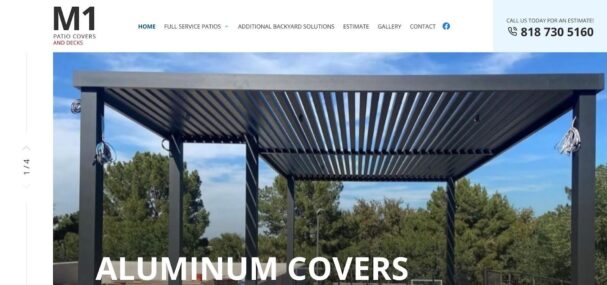
M1 Patio Covers website screenshot showing premium 4K aluminum patio covers.
The North Hills firm brings 35 years of aluminum craft to every job. Its signature 4K aluminum mimics stained wood yet resists termites, rust, and August heat.
Speed sets M1 apart. Because the engineers work in-house, plans reach Glendale’s portal the same week you sign off, and crews can install in about three weeks, arriving with touch-up paint for every fastener.
Expect $40–$60 per sq ft, but clients focus on results: a cover that lines up with La Cantina doors, drops evening temperatures by about 10 °F, and looks original to the house.
If you want a statement piece with zero upkeep, finished before pool season, M1 leads the aluminum pack.
3. GnG Vinyl: the hometown fabricator with a personal touch
Step into GnG’s Colorado Street showroom and you feel the local edge: samples on the wall, crews sharing photos, and the owner greeting repeat visitors by name. Behind that warmth sits serious manufacturing muscle. GnG extrudes its own vinyl, inserts steel where spans run long, and machines every lattice tail in the shop.
In-house fabrication matters for two reasons. Quality control: you know exactly which UV-stabilized PVC goes into each plank. Customization: posts can be trimmed a half-inch to clear a tricky eave before the parts leave the floor.
Pricing lands at $20–$23 per sq ft for a typical 200 sq ft solid roof, and you still get a limited lifetime warranty plus full Glendale permit handling.
Reviews praise communication: crews arrive on time, leave the yard spotless, and swing by a month later to confirm nothing has settled. Small gestures build big trust.
If you want vinyl durability wrapped in neighborly service, GnG feels more like teaming up with a friendly expert than hiring a contractor.
4. Tiger Patio: modern lines for design-forward homes
When black-framed sliders, minimalist planting, and smart-home gear set the tone, Tiger Patio delivers matching shade structures.
The boutique crew models every project in 3D, letting you spin the pergola on a tablet before a single cut. Expect powder-coated aluminum, slim steel posts, and motorized louvers, yet budgets stay mid-market at $35–$55 per sq ft.
Because the team is small, the owner walks each job, answers texts the same day, and tweaks details on site. Need LED grooves cut this afternoon? Done. Want a side screen for late-day glare? Routed and wired while the posts are open.
Permits move smoothly: stamped calculations hit the Glendale portal early, so approvals glide through and builds finish in about six weeks, quick for fully custom work.
Choose Tiger Patio if style matters as much as shade and you want one nimble crew guiding your vision from first sketch to final sweep-up.
5. Elite LA Patios: where outdoor rooms turn luxe
Elite LA Patios lifts a basic cover into resort-grade space with wood-grain 4K aluminum, sculpted columns, dimmable sconces, and recessed heaters for December dinners. After 30 years in the shade trade, the promise is simple: give clients a luxury look without the cost of a full remodel.
Consultations feel like mini design charrettes. A project lead maps traffic flow, ceiling height, and sight-lines, suggesting upgrades only when they solve a need. The bestseller is a motorized louvered roof that stays dry at noon and opens to stars by nine. Expect $40–$60 per sq ft; every moving part carries a 30-year finish warranty and arrives pre-wired for future gadgets.
Timelines are honest. Elite posts real start dates instead of “maybe next month” placeholders. Once on site, posts set on day 1, the roof locks by day 4, and the punch list closes before the dumpster leaves.
Choose Elite when you want a patio that feels like a true outdoor living room, complete with mood lighting, audio, and finishes that make guests ask for the contractor’s number before dessert.
6. LA Patio Covers: veteran craftsmanship, zero drama
LA Patio Covers skips Instagram ads; 30 years of word-of-mouth in Glendale keeps the phones ringing. Seasoned carpenters, straight quotes, and an owner who still straps on a tool belt form the core recipe.
Flexibility is the hook. One crew can frame a cedar pergola that matches a 1920s Craftsman, while another swaps tired plywood for insulated aluminum panels that cut afternoon heat by about 15 °F. Whatever you choose, the focus stays on durability, not curb appeal that peels after three summers.
Budgets remain friendly. Lean overhead means bids often run 10–15 percent below larger brands without skimping on hardware or footings. Every line item is spelled out, so change orders are rare and modest.
Process is low-key: measure on Monday, plans filed by Friday, and construction finished roughly two weeks after permit approval. No showroom, just crews who sweep twice and shake hands when the inspector signs off.
If you want veteran skill over flash, and a cover that feels original to your home, LA Patio Covers is a solid, drama-free choice.
7. Universal Awning & Canopy: commercial muscle for residential shade
Universal Awning designs shade structures for shopping centers and stadium concourses, then brings the same industrial strength to Glendale backyards. At the Reseda plant crews weld thick-wall aluminum that spans wide patios without forest-like posts, powder-coat in any color, and stitch marine-grade fabric for retractable options.
The factory-direct model delivers creativity—picture a cantilevered canopy floating over a hillside deck or a sail that mirrors your pool—and durability: commercial hardware shrugging off Santa Ana gusts while still looking fresh 10 years later.
Pricing skews premium at $35–$70 per sq ft, especially for motorized awnings or steel frames, yet owners rave about long-term value. You notice it when a beam stays rock steady and seams roll out smooth and silent.
Multiple install crews keep lead times reasonable, even during spring rush. Universal also handles permits, HOA color boards, and, unlike many competitors, runs a staffed service department that answers the phone years after install.
Choose Universal when you want commercial-grade performance and a one-of-a-kind design that makes guests pause the moment they step outside.
8. Patios4All: the one-stop backyard remodeler
Most contractors stop at the beam line; Patios4All keeps going until the last paver is sealed and the grill sparks. As a division of a full-service remodeling group, the firm bundles concrete, electrical, hardscape, and cover work under one project manager. One invoice, fewer headaches, and trades that overlap instead of collide.
Material choice is wide open. Consultants compare wood warmth with Alumawood ease, vinyl’s low upkeep with steel’s slim profile, and price each option on the spot. A popular package is a 10 × 20 ft Alumawood lattice installed for about $25 per sq ft, backed by factory warranties.
Speed is solid. With multiple in-house crews, small covers can break ground within three weeks of permit approval. Larger combinations—a cover plus stamped concrete and a gas line—run longer but still beat multi-contractor schedules.
Reviews highlight tight organization: clear calendars, daily cleanup, and a foreman who texts a progress recap every evening. If something shifts, you know before breakfast.
Choose Patios4All when the patio cover is just chapter one of a full Glendale backyard makeover and you want one accountable team from first dig to final rinse.
9. FirstBridge Sunrooms & Patios: permit-to-key enclosure experts
A four-season room sounds great until the 28-page permit checklist lands on your desk. FirstBridge loves that paperwork. The Glendale team designs, engineers, and shepherds each enclosure through city plan check, HOA review, and final inspection, then hands you the keys.
The specialty is insulated aluminum roof panels paired with low-E glass walls. The combo beats summer heat, meets California Title 24 energy codes, and feels like real living space, not a bolt-on box. Expect $45–$70 per sq ft, a figure that already includes stamped engineering, permit fees, and inspections.
Transparency wins praise. You get a Gantt chart with tasks, target dates, and responsible names before ground-break. Missed milestone? The team flags it and issues a fix the same day.
Field work runs tight—footings first, prefab wall panels next, roof last—often finishing in under two weeks. Because crews focus solely on enclosures, details pop: flush thresholds, sealed joints, fan boxes pre-wired.
Choose FirstBridge when you need square footage that feels native to the house and prefer to hand the red tape to a pro.
10. Superior Awning: forty years of bespoke shade
Superior Awning works more like a craftsman’s studio than a factory. In the Van Nuys shop you’ll see powder-coat ovens humming beside tables where technicians trim Sunbrella to the millimetre. That end-to-end control lets them build anything from a classic Alumawood cover with molded corbels to a steel cabana wrapped in striped Italian acrylic.
Because every part is produced in-house, colour choice stretches far past standard whites. Want a matte-black beam that echoes new window trim? They spray it that afternoon. Need columns matched to terra-cotta roof tiles? A quick chip scan sets the formula. Finished pieces carry a lifetime paint warranty and the heft of commercial hardware.
Pricing runs $25–$60 per sq ft depending on features, sitting mid-premium for the craftsmanship. Clients say the extra finish shows up in resale value and instant curb appeal. Crews are just as meticulous: laser-level posts, caulk every seam, and wipe fingerprints before rolling off.
Scale is another edge. Multiple installation teams keep lead times reasonable even when spring orders spike, and a dedicated service desk can run an extra strap to site the same day an inspector asks.
Choose Superior Awning when you want a patio cover that looks custom-built for the architect’s portfolio and designed to shrug off trends, termites, and the occasional flying soccer ball.
11. California Pergola Systems: engineering first, style a close second
California Pergola Systems (CPS) shows that structural math and sleek design can share the same blueprint. Every project starts with load calculations based on Glendale wind maps and seismic zones, and the drawings arrive stamped by a licensed engineer, shaving days off plan-check ping-pong.
Once safety is locked, design gets fun: choose classic open-beam redwood, insulated aluminum panels, or a hybrid gable that blends both. Timelines stay tight, with a typical two-week permit turn-around followed by a three-day install, thanks to prefab panels and year-round pergola crews.
Cost lands mid-pack at $30–$55 per sq ft, and that figure already covers engineering, permit fees, and a 15-year structure warranty. Tech-minded owners appreciate the extras: recessed LED ribbons, fan mounts, and pre-wired conduit for future solar.
If you want solid engineering wrapped in clean California lines, CPS delivers safety and style in one fast package.
12. Danny Deck Construction: hand-built wood warmth
When only real lumber will do, Danny Deck Construction is the craft team to call in Glendale. The family crew shapes redwood and cedar with mortise-and-tenon joints, decorative rafter tails, and hidden stainless hardware. Each beam is planed on site, stained twice, and sealed to handle the Valley’s dry heat.
Custom wood demands time and muscle, so budgets run $50–$75 per sq ft depending on beam size and roof finish. The payoff is irreplaceable character, from tongue-and-groove ceilings under Spanish tiles to a cedar pergola that weathers to silver.
Danny visits every project, sketches details in pencil, and stays available by text until the last coat of sealer dries. Reviews note perfect lines, meticulous cleanup, and crews who treat gardens and pets with care.
Upkeep is straightforward: rinse dust each spring and reseal top surfaces every three years. Prefer to relax? The team offers an affordable check-up service to keep the wood glowing.
Choose Danny Deck when you crave the scent of fresh cedar and prefer made-to-measure craftsmanship instead of zero-maintenance materials.
Glendale buyer’s mini-guide
1. Permits and HOA approvals
Glendale treats any shade structure with a solid roof as a regulated patio cover. You will need:
- A building permit with stamped structural drawings
- Two inspections: post anchors and final
- About $200–$500 in city fees, with an average two-week plan check when calculations are clean
Open lattice covers under 200 sq ft often sail through as exempt, but add a solid panel or attach to the fascia and you return to permit land. Live in an HOA? File the city-stamped drawings plus a paint chip; most boards vote within seven to fourteen days.
2. Material lifespan and upkeep
| Material | Typical service life | Upkeep rhythm | Best fit |
| Powder-coated aluminum | 20–30 years | Hose off twice a year; clear gutters | Zero-maintenance shade |
| High-grade vinyl | 15–25 years | Rinse annually; inspect fittings | HOA-friendly whites |
| Redwood or cedar | 10–20 years | Reseal every two to three years | Historic or rustic homes |
| Galvanized steel | 20 years plus | Touch-up paint on scratches | Long spans, slim posts |
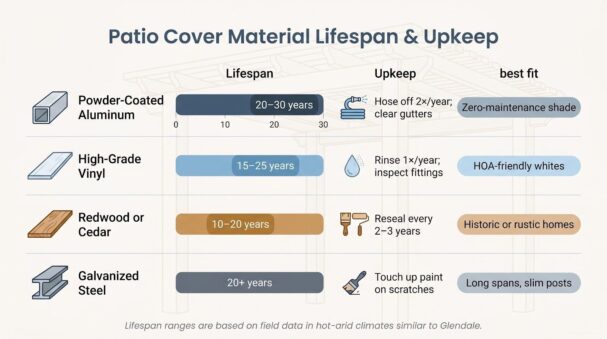
Data adapted from field studies in hot-arid climates similar to Glendale.
3. Real-world costs and payback
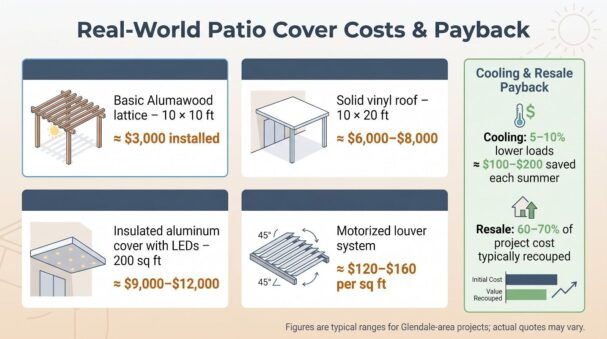
- Basic 10 × 10 ft Alumawood lattice: about $3,000
- Solid vinyl roof 10 × 20 ft: $6,000–$8,000
- Insulated aluminum cover with LEDs 200 sq ft: $9,000–$12,000
- Motorized louver system: $120–$160 per sq ft
A solid cover on a west wall can trim cooling loads by five to ten percent, saving $100–$200 each summer. Realtors estimate a quality structure recoups sixty to seventy percent of its cost at resale.
4. Quick maintenance checklist
- Aluminum or vinyl: hose off debris each spring.
- Wood: rinse, then reseal horizontal surfaces every third year.
- Fabric awnings: brush off dust monthly and retract in high winds.
Follow these rhythms and your cover should outlast its warranty while sparing you emergency repairs when the Santa Anas blow through.
1. Permits and HOA approvals
Skip the paperwork and you risk a stop-work order. Glendale sees any shade structure with a solid roof—vinyl, Alumawood, or glass—as a regulated patio cover. You will need stamped drawings, a building-department plan check, and two inspections. Fees run about $225–$750, and simple patio plans clear review in about two weeks when calculations are clean.
Open lattice covers under two hundred sq ft are usually exempt, but add a solid panel or tie into the fascia and you are back in permit territory. Let your contractor file online, pay the fee, and meet the inspector; every company in our top twelve bundles that service into its quote.
HOA approval can add seven to fourteen days. Most boards want matching colors, a total height of ten ft or less, and gutters that keep runoff off your neighbor’s roses. Submit city-stamped drawings, a paint chip, and a drainage note and you will usually get a yes on the first vote.
Plan on one to three weeks of desk time before post holes and budget a few hundred dollars for fees. The smoother that prep, the faster you reach pour day.
2. Material lifespan and upkeep
| Material | Service life | Upkeep rhythm | Best for |
| Powder-coated aluminum | twenty to thirty years | Hose off twice a year; clear gutters | Zero-maintenance shade and modern lines |
| High-grade vinyl | fifteen to twenty-five years | Rinse and inspect fittings yearly | HOA-friendly white covers |
| Redwood or cedar | ten to twenty years | Reseal every two to three years; termite check | Warm aesthetics, historic homes |
| Galvanized steel | twenty years plus | Touch-up scratched paint promptly | Long spans, slim posts |
(Table life spans come from Phoenix field data; Glendale’s slightly milder heat trends toward the high end of each range.)
3. Real-world costs and payback
- Ten × ten ft Alumawood or vinyl lattice: about $3,000 installed
- Upgrade to a solid roof plus a ceiling-fan beam: add $2,000
- Insulated aluminum cover 200 sq ft with recessed LEDs: $9,000–$12,000
- Motorized louver system: $120–$160 per sq ft
Prices include labor and an average Glendale permit; electrical extras ride on top.
What do you gain? Studies for hot-arid climates show exterior shade can cut solar heat gain on west-facing glass by sixty-five to seventy-seven percent, trimming cooling energy five to ten percent. On a typical Glendale summer bill that is roughly $100–$200 saved per year.
Real-estate data helps, too. Remodeling Magazine’s Cost-vs-Value report lists a sixty to seventy percent recoup rate for permanent outdoor structures in the Los Angeles market.
Combine lower air-conditioning use with higher appraised value and the payback horizon shortens—while you enjoy shaded living space the entire time.
4. Quick maintenance checklist
- Aluminum or vinyl: hose off debris each spring.
- Wood: rinse, then reseal horizontal surfaces every third year.
- Fabric awnings: brush off dust monthly and retract in high winds.
Follow these rhythms and your cover should outlast its warranty and spare you emergency repairs when Santa Ana winds blow through.
1. Permits and HOA approvals
Glendale’s building department treats any solid-roof shade structure as a patio cover that needs a permit. You will submit stamped structural drawings, pay about $225–$750 in fees, and pass two inspections. A clean set of calculations usually clears plan check in about two weeks.
Open lattice covers under two hundred sq ft are often exempt, but once you add a solid panel or connect to the fascia you move back into permit territory. All twelve recommended contractors include filing, fee payment, and inspection visits in their quotes, so you are not stuck at city hall.
Homeowner associations add seven to fourteen days. Most want a matching color, a total height of ten ft or less, and gutters that direct runoff away from neighbors. Submit city-stamped drawings, paint samples, and a drainage note and most boards approve on the first vote.
Budget a few hundred dollars and one to three weeks of desk work before concrete day; smooth paperwork makes on-site progress faster.
2. Material lifespan and upkeep
| Material | Typical service life | Upkeep rhythm | Best fit |
| Powder-coated aluminum | twenty to thirty years | Hose off twice a year; clear gutters | Zero-maintenance shade |
| High-grade vinyl | fifteen to twenty-five years | Rinse annually; check fittings | HOA-friendly white finishes |
| Redwood or cedar | ten to twenty years | Reseal every two to three years; termite check | Warm aesthetics, historic homes |
| Galvanized steel | twenty years plus | Touch up paint on scratches | Long spans, slim posts |
The figures come from field studies in Phoenix and Las Vegas, so Glendale’s slightly milder heat often places real results near the top of each range.
Key takeaways
- Aluminum lasts the longest with almost no upkeep, perfect when you want to install it and forget it.
- Vinyl stays cool to the touch and never rusts, though color choices stay limited.
- Wood looks unmatched on day one and can reach twenty years if you keep up the reseal cycle; skip maintenance and UV rays will cut that life quickly.
- Steel delivers dramatic, slender posts but needs prompt paint touch-ups on any nicks to stop rust.
3. Real-world costs and payback
- Ten by ten ft Alumawood or vinyl lattice: about $3,000 installed
- Upgrade to a solid roof and ceiling-fan beam: add about $2,000
- Insulated aluminum cover 200 sq ft with recessed LEDs: $9,000–$12,000
- Motorized louver system: $120–$160 per sq ft
A solid cover on a west-facing wall can trim cooling loads by five to ten percent, saving $100–$200 each summer. Real-estate reports show a quality structure recoups sixty to seventy percent of its cost when you sell.
4. Quick maintenance checklist
- Aluminum or vinyl: hose off debris each spring.
- Wood: rinse surfaces, then reseal horizontals every third year.
- Fabric awnings: brush off dust each month and retract during high winds.