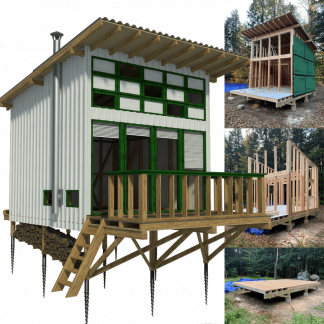
Most of us who fall in love with small-structure building start the same way: a stack of timber, a circular saw, a set of cabin plans, and a free weekend. Wood framing is forgiving, affordable, and endlessly satisfying to work with. It is the right answer for the overwhelming majority of tiny houses, garden sheds, and weekend cabins.
But at some point a lot of DIY builders run into the same wall. The backyard studio grows into a workshop. The single cabin becomes a pair of rental units. The “small barn” the family wanted turns out to need a 40-foot clear span with no posts in the middle. That is the moment the conversation quietly shifts from which lumber to whether wood is still the right material at all.
This guide walks through the honest trade-offs between wood framing and light-gauge or structural steel, so you can decide where your own project lands.
How wood and steel framing actually differ
Wood framing relies on dimensional lumber, studs typically spaced 16 or 24 inches on center, joined with nails and standard hardware. Almost anyone can learn it, the tools are cheap, and a single person can carry the material. Its weaknesses are familiar too: it burns, it can rot, it feeds termites, and it moves with moisture and time.
Steel framing splits into two very different categories, and it is worth keeping them separate in your head.
Light-gauge (cold-formed) steel is the closest cousin to wood. It uses thin galvanized C-shaped studs that go up in walls and partitions much like timber studs, but they are dimensionally stable, non-combustible, pest-proof, and consistent from one piece to the next. Builders working on interior partitions and smaller wall assemblies have used it as a wood alternative for decades precisely because it is fire-resistant and easy to erect.
Structural (red-iron) steel is a different animal entirely. Here vertical steel columns and horizontal beams form a rigid skeleton that carries the floors, roof, and walls hung off it. This is the system that makes wide-open, column-free interiors possible, and it is the backbone of nearly every steel workshop, warehouse, or agricultural shed you have seen. For builders whose plans have outgrown timber, it opens up steel building options for larger projects that simply are not practical in wood.
Where wood clearly wins
Let me be blunt, because this is a small-house blog and honesty matters more than selling anyone a different material.
For a true tiny house, a garden shed, a playhouse, a gazebo, or a one-room cabin you intend to build yourself, wood is almost always the better choice. The material is cheap and available everywhere, you do not need specialized fasteners or crews, and the entire structure can go up with hand tools and one or two helpers. Wood also takes finishes beautifully and gives you that warm, organic feel that draws most of us to small cabins in the first place. Nothing about steel improves a cozy 12-by-16 weekend retreat.
If your project fits comfortably inside a standard set of cabin or shed plans, stop reading and go build it in timber. You will be happier.
Where steel starts to make sense
Steel earns its place once a build crosses certain thresholds. Watch for these signals:
You need a large clear span. Wood roof systems get awkward and expensive past roughly 20-24 feet without intermediate support. If you want an open workshop, a two-car garage, a small barn with no center posts, or an equipment shed, a steel frame handles the span far more gracefully.
The structure is bigger than a hobby project. Once you are talking about a real workshop, a storage building, a small commercial space, or anything you will insure and permit as a substantial structure, steel’s strength-to-footprint ratio and predictable engineering become genuinely valuable.
Durability and low maintenance are priorities. Quality steel buildings use hot-dip galvanizing to resist rust for decades and are engineered to shrug off high winds and heavy snow loads. They do not rot, warp, or feed insects, and good systems are built to last 50 years or more with minimal upkeep.
Speed matters. Because components are cut and punched in a factory, a pre-engineered steel building goes up dramatically faster on site than equivalent stick framing, often cutting construction time by a third or more. For anyone trying to beat a season or a deadline, that gap is real.
You want predictable cost on a larger footprint. On small structures wood is cheaper, full stop. But as square footage and span grow, the labor savings and material efficiency of a prefabricated steel kit start to close, and sometimes reverse, the cost gap.
The hybrid reality most builders land on
Here is the part nobody tells you at the lumber yard: it is rarely all-or-nothing. Plenty of property owners build the cozy cabin or guest house in timber exactly as planned, then put up a separate steel structure for the workshop, garage, or barn where span and durability matter more. The two materials are complementary, not rivals. A warm wooden cottage and a no-nonsense steel workshop can sit happily on the same plot, each doing what it does best.
Cold-formed steel also shows up inside otherwise wood-framed projects: steel for the load-bearing or fire-sensitive walls, timber for everything else. Mixing materials by their strengths is a perfectly legitimate, and increasingly common, approach.
A quick decision checklist
Before you commit, run your project through these questions:
- Span: Do I need more than ~20 feet of unsupported width? → lean steel.
- Size: Is this a hobby build or a substantial, permitted structure? → larger leans steel.
- Skills and crew: Am I building solo with hand tools, or do I have equipment and help? → solo leans wood.
- Lifespan: Do I need 50+ years of low-maintenance service? → leans steel.
- Feel: Do I want warmth and a hand-built character? → leans wood.
- Budget at my size: At a small footprint wood wins on cost; at a large footprint, get quotes for both.
If most of your answers point at timber, you are in exactly the right place on a small-house site, and you should build with confidence. If they keep pointing the other way, it is worth getting an engineered quote before you buy a single board.
Conclusion
Wood framing built the tiny-house movement, and it remains the heart of DIY small-structure building. But “small and wooden” and “large and steel” are not opposing camps so much as different tools for different jobs. Knowing where the line sits, somewhere around the point your span, size, or durability needs outgrow what lumber comfortably handles, is what separates a frustrating build from a smart one.
Start small, build in wood, and enjoy it. And if your plans ever grow past what timber wants to do, you will know exactly when it is time to look at steel instead.