
The mini split brands to avoid in 2026 are unbranded Amazon imports with no parts network, brands with no US-based support line, and flare-install units marketed as “DIY” to buyers who don’t own a vacuum pump.
That does not mean every inexpensive mini split is junk. It means the cheapest system becomes a bad purchase when nobody can supply a control board, the warranty requires paperwork you never completed, or the “easy DIY installation” turns out to require refrigerant tools and experience.
Spend enough time in owner forums and warranty-dispute threads and you stop caring about the badge on the front of the unit. What matters is what happens three years later, when the indoor fan motor stops or the system throws an unfamiliar error code. A mini split is only repairable when parts, service information and competent support still exist.
There is no trustworthy public database ranking every mini split brand by long-term failure rate. Anyone confidently declaring one brand the “worst” is usually relying on personal experience, owner complaints or marketing, not controlled reliability data. A more honest approach, and the one this guide takes for the 2025–2026 market, is to identify the buying patterns most likely to leave homeowners stranded.
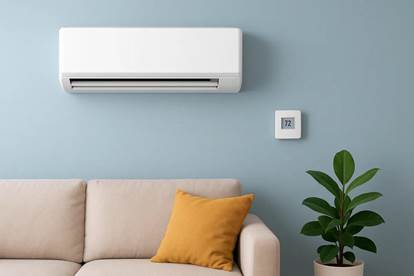
Suggested alt text: Wall-mounted mini split indoor unit in a living room. Knowing what brand of mini split to avoid starts with parts and warranty checks, not the badge on the unit.
Mini split red flags to recognize
| Risk pattern | What actually fails | How to spot it before buying | Documented example |
| Marketplace-only or unfamiliar brand | Control boards, fan motors, temperature sensors and remotes become difficult or impossible to replace | Search the exact model number plus “control board,” “fan motor” and “parts diagram” before ordering | HVAC technicians and owners discussing off-brand imports on r/hvacadvice repeatedly describe weak parts support and difficulty finding contractors willing to repair them |
| No functioning US support network | The original failure may be minor, but diagnosis and warranty authorization stall | Call the published support number before buying and ask how to order a replacement main board | Owners and technicians warn that online-only brands without technical support may be treated as disposable equipment when they fail |
| Conventional flare unit presented as beginner DIY equipment | Refrigerant leaks, moisture contamination, loose electrical connections and damaged flare fittings | Read the installation manual. Look for pressure testing, evacuation, micron-gauge or licensed-installer requirements | Senville explicitly says it does not offer DIY installation kits and requires refrigerant work to be completed by a licensed HVAC technician to maintain warranty coverage |
| Registration-gated or installation-gated warranty | The equipment fails, but the claim is denied or reduced because registration or installation documentation is missing | Download the complete warranty, not just the warranty badge on the product page | Pioneer states that registration within 90 days provides its five-year warranty extension, while its coverage also depends on installation being completed correctly |
| Confusing warranties across product lines | The buyer assumes every system sold under the same brand has identical coverage | Search the exact series and generation on the manufacturer’s warranty page | MRCOOL’s DIY 5th Generation carries five-year parts and seven-year compressor coverage, but other MRCOOL lines have different terms |
Brands and types to avoid
1. No-name mini splits with no parts availability
The highest-risk purchase is not necessarily a recognizable budget brand. It is the system sold under a name that appears to exist only on one marketplace listing.
These units can cool perfectly well when new. Many are built by experienced overseas manufacturers using familiar compressor and inverter technology. The problem comes later. The marketplace seller may disappear, the model number may change, and there may be no searchable parts catalog.
That makes a failed $40 sensor or indoor control board functionally equivalent to a failed compressor. The component may be inexpensive, but you cannot repair the system if you cannot identify or obtain it.
Owners and HVAC technicians discussing off-brand systems on r/hvacadvice frequently identify parts support and contractor willingness as the biggest problems, not necessarily immediate cooling performance.
Balancing positive: An inexpensive no-name system can make financial sense for a lightly used workshop, temporary building or garage when the buyer accepts that it may eventually be replaced rather than repaired.
For a bedroom, primary living area or cold-climate heating application, that gamble is harder to justify.
2. Brands without a reachable US support operation
A warranty is not very useful when it leads to an unanswered email address.
Before purchasing, call the manufacturer. Do not merely ask whether the warranty exists. Ask a technical question:
I own model XYZ. How would I purchase an indoor control board after the warranty expires?
A credible support operation should be able to explain how parts are identified, ordered and shipped. Better companies publish service manuals, exploded diagrams, error-code documentation and dedicated parts-request forms.
Pioneer, for example, maintains a support library and a specific process for requesting spare parts. Senville publishes a North American support number and an online troubleshooting center.
Those resources do not guarantee a perfect warranty experience, but they are far better than a marketplace seller that can only offer a return during the first 30 days.
3. “DIY” flare systems bought by people without HVAC tools
A conventional flare-connected mini split can be installed by a skilled homeowner. That does not make it a tool-free DIY system.
A proper flare installation generally involves correctly formed and torqued fittings, leak testing and evacuating the line set before refrigerant is released. Skipping evacuation can leave air and moisture inside the refrigerant circuit. A poorly made or over-tightened flare can leak months after installation.
Senville is a useful example of why buyers must separate “available online” from “designed for DIY.” Senville says homeowners may mount the equipment, but refrigerant work must be performed by a licensed HVAC technician to preserve warranty coverage.
Balancing positive: Senville is not inherently a brand to avoid. Its systems are attractively priced, it maintains North American support, and its published warranty can reach five years on parts and ten years on the compressor for certain Aura models. A properly equipped installer can make a Senville an excellent budget purchase.
The risk is buying it under the assumption that it installs like a sealed quick-connect system.
Pioneer belongs in a similar category. It can be a sensible budget system for someone who understands flare work, evacuation and installation documentation. It is a poor choice for a beginner expecting to connect two pipes by hand and turn the unit on.
4. Thin, confusing or registration-dependent warranties
Never compare warranties by the largest number printed on the product page.
Check:
- Parts coverage
- Compressor coverage
- Labor coverage
- Registration deadline
- Professional-installation requirement
- Shipping charges
- Diagnostic documentation required
- Whether replacement parts are available after warranty expiration
The Federal Trade Commission recommends reading what is excluded, determining who handles claims and checking whether the consumer must pay labor or return-shipping costs. It also recommends saving the warranty and purchase receipt.
Registration requirements are common even among premium brands. Mitsubishi offers up to 12-year parts and compressor coverage for qualifying residential systems installed by eligible contractors and registered within 90 days. Daikin advertises 12-year parts coverage on qualifying products when online registration is completed within 60 days.
Those are strong warranties when the conditions are followed. They become much less valuable when a homeowner buys equipment online and assumes the longest advertised coverage applies automatically.
A quick sanity checklist
Run these five checks before buying any mini split. They take about ten minutes and can prevent an expensive mistake.
1. Search for replacement parts
Search the exact outdoor-unit model number with:
- Main control board
- Indoor fan motor
- Outdoor fan motor
- Temperature sensor
- Remote control
- Parts diagram
Finding filters and remotes is not enough. You want evidence that functional repair parts are identifiable and obtainable.
2. Read the actual warranty
Locate the complete warranty document. Search it for “registration,” “licensed,” “professional installation,” “labor,” “shipping” and “proof of purchase.”
Take screenshots or save a PDF on the purchase date.
3. Test the support line
Call before buying. Ask a real parts or installation question. A company that cannot help a prospective buyer is unlikely to become easier to reach after a failure.
4. Check the refrigerant
R-32 and R-454B are the main current-generation lower-GWP refrigerants appearing in new residential equipment. R-410A is now legacy inventory, although current EPA rules still allow its sale and installation in certain inventory and component-replacement situations. It is not automatically illegal or unusable.
The concern is long-term positioning. Before buying an R-410A system in 2026, confirm its manufacture date, warranty support and replacement-component availability.
5. Identify the installation type
Determine whether the system uses:
- A factory-sealed, pre-charged quick-connect line set
- A pre-vacuumed line set
- Conventional field-made flare connections
- A line set that must be evacuated and possibly adjusted for charge
“Pre-charged outdoor unit” does not mean “no vacuum pump required.” Nearly every conventional mini split condenser arrives with refrigerant in it. What matters is whether the connecting line set remains sealed from the factory through installation.
What to buy instead
There is no single best brand for every buyer. Choose the category that matches your installation plan.
Established DIY leader: MRCOOL
MRCOOL remains the established leader in the US DIY mini split category. Its DIY systems use pre-charged connections intended to remove conventional evacuation from the installation process, and the DIY 5th Generation carries five-year parts and seven-year compressor coverage.
Owner reports about warranty service are mixed, so keep receipts, register when required and document the installation. Some owners report frustrating parts delays, while others report receiving substantial replacement equipment under warranty.
Newer direct-to-consumer DIY option: Zone Air
Zone Air sells factory pre-charged DIY systems backed by a 7-year compressor and 5-year parts warranty that doesn’t require registration.
Run the same ten-minute checklist on Zone Air that you would run on any other brand in this guide. The parts search and the support call take a few minutes each, and a direct-to-consumer company should pass both without friction.
Premium professional installation: Mitsubishi, Daikin and Fujitsu
Mitsubishi, Daikin and Fujitsu are stronger choices when long-term serviceability, established contractor networks and cold-climate product options matter more than initial cost.
Their best warranty terms generally depend on proper installation and timely registration. These are not the systems to purchase casually online and then ask the lowest bidder to install.
Budget conventional-flare systems: Senville and Pioneer
Senville and Pioneer are reasonable value choices for buyers who have access to an HVAC technician or genuinely understand nitrogen testing, flare preparation, torque and evacuation.
They are not equivalent to sealed-line DIY systems. That difference should be reflected in your installation budget.
Midea, Cooper & Hunter, Tosot, Perfect Aire and Blueridge sit in the same conventional-install category. None of them belongs on an avoid list by name. Judge each model with the checklist above rather than by brand reputation alone.
Della competes heavily on purchase price. Treat it as a model-by-model decision and complete the parts-and-support test before ordering.
EG4 is most interesting for solar and energy-independence applications. Its current mini split products include Plug-N-Cool or pre-charged configurations and published five-year limited warranties on qualifying models.
Cheap does not automatically mean bad
A $900 flare-based Senville installed by someone who owns a vacuum pump, micron gauge, nitrogen regulator and torque wrench can be a much better purchase than a $2,000 DIY system installed carelessly.
Likewise, a premium Mitsubishi installed badly can leak, drain incorrectly or perform poorly.
The main risk is mismatch:
- Wrong system for the buyer’s skill level
- Wrong equipment for the climate
- Wrong warranty for the installation method
- Wrong brand for the expected service life
Buy the support structure and installation method, not just the efficiency number printed on the listing.
Frequently asked questions
What brand of mini split should I avoid?
Avoid unbranded marketplace systems with no verifiable parts network, no functioning US support line and no clear written warranty. Also avoid conventional flare systems advertised as simple DIY products when you do not have the tools or qualified help needed to evacuate and test the refrigerant lines.
What are the worst mini split brands?
There is not enough independent failure-rate data to name one universally worst brand. The highest-risk products are marketplace-only labels with changing model numbers, weak technical support, unavailable repair parts and warranties that depend on conditions hidden deep in the fine print.
What is the most reliable mini split brand?
Mitsubishi and Daikin are commonly treated as premium professional-install choices because of their established product lines, contractor channels and extended warranty programs. Reliability still depends heavily on sizing, installation quality, maintenance and local parts support.
For true homeowner installation, compare dedicated sealed-line DIY systems separately from conventional mini splits.
Are cheap Amazon mini splits any good?
Some are surprisingly capable. Many use proven inverter technology and can provide years of heating and cooling.
The problem is not always the original equipment. It is what happens when the unit needs a board, motor or sensor. A cheap Amazon mini split is a reasonable gamble for a noncritical space when the buyer accepts limited repairability. It is a much riskier choice as the primary heating system for an occupied home.