
A favorite lamp can hold a room together. It may be the light beside a reading chair, the desk lamp that has survived three apartments, or the vintage floor lamp that makes an otherwise plain corner feel finished. When it starts flickering, refuses to turn on, or feels unsafe to plug in, the decision is not always simple. Do you repair it, replace it, or stop using it altogether?
For homeowners in New York, that question usually comes down to condition, safety, and whether the lamp still earns its place in the room. A damaged cord, faulty socket, unreliable switch, loose plug, or aging wiring does not always mean the lamp should be discarded, especially if the structure, shade, base, and design still work well in the home. When the issue appears repairable but involves electrical parts, searching for lamp repair NYC gives homeowners a practical way to assess whether a valued lighting piece can be made safe and useful again.
Start With Electrical Warning Signs
Unplug a lamp if the cord is frayed, the wire is exposed, the plug feels loose, the socket moves, or there is a burning smell, buzzing sound, or repeated flickering. The same applies if the lamp only works when the cord is bent, twisted, or held in position. Those symptoms point to a connection problem, not a minor inconvenience.
The National Fire Protection Association reported that from 2020 to 2024, U.S. fire departments responded to an estimated annual average of 46,652 home structure fires involving electrical failure or malfunction. A faulty lamp is not automatically a fire hazard, but damaged cords, loose sockets, and unreliable connections should be checked before the lamp is used again.
Do not keep switching the lamp on, bending the cord, or adjusting the plug to make it work. That only confirms the fault is still active.
Repair Makes Sense When the Lamp Has Real Value
Repair is worth considering when the lamp has value that a quick replacement cannot easily match. That may be an inherited piece, an antique lamp, a designer fixture, a mid-century floor lamp, or a table lamp chosen specifically for its height, shade shape, finish, or fit within the room.
This is especially true when the visible structure is still sound, and the problem is likely internal. A worn cord, loose socket, faulty switch, damaged plug, or aging wiring may compromise safety and daily use, but it does not automatically render the entire lamp disposable.
Replace When the Lamp Was Never Worth Much
Replacement is usually the better decision when the lamp has limited value, and the damage affects more than a repairable component. A cracked base, ruined shade, unstable frame, inaccessible parts, or poor original construction can make repair less practical than choosing a better lamp that fits the same room.
Cost should also be weighed against usefulness. If the repair approaches the price of a better-quality replacement and the lamp has no sentimental, design, or daily-use value, keeping it becomes habit rather than judgment. Some lamps are worth assessing because they still matter. Others are simply taking up space.
Consider Energy Use Without Throwing Everything Away
Repair can also be the better choice when the lamp still works for the room but needs safer, more efficient performance. A well-made older lamp with a sturdy base, a suitable shade, and a useful placement does not always need to be replaced simply because one internal part has failed.
That decision becomes more practical when efficiency is part of the equation. The U.S. Department of Energy notes that lighting accounts for about 15% of an average home’s electricity use, and that switching to LED lighting can reduce household energy costs. If the lamp can be safely repaired, it may continue serving the room while supporting a more efficient bulb choice.
That does not make every older lamp worth saving. Some need more work than they justify. But when the fixture is sound, and the repair is targeted, keeping the lamp can be a practical middle ground between wasteful replacement and unsafe continued use.
Read the Symptoms
A useful way to judge the lamp is to separate the fault into power, structure, and fit. Power issues affect whether the lamp works safely, structural issues affect whether it can stand, hold the shade, or remain stable, and fit issues affect whether the lamp still belongs in the room. If the lamp no longer suits the space, replacement may be the right answer even if repair is possible. If the frame, base, or shade support is damaged but can be repaired, repair may still be practical. If the issue is electrical, the lamp should be assessed before further use rather than treated as a decorating inconvenience. The better question is not only whether the lamp can be fixed, but also whether fixing it will make it safe, useful, and worth keeping.
Use Cost as One Factor
Knowing when to repair or replace is about judging what the lamp still gives back to the home. A basic lamp that is easy to replace may not justify much attention, while an antique, designer, inherited, or perfectly scaled piece may be worth repairing because it would be difficult to match in quality, proportion, or meaning.
A clear decision should consider how often the lamp is used, how well it fits the room, how difficult it would be to replace, and whether the fault is limited to parts that can reasonably be corrected. A proper diagnosis helps separate a lamp that simply needs targeted repair from one that has reached the end of its useful life.
Use Repair Expertise Before You Decide
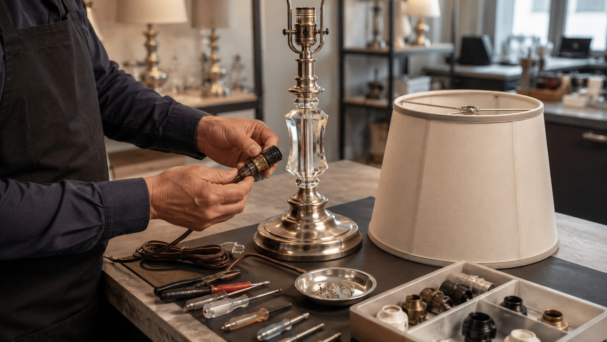
Knowing where to take a lamp matters because repair decisions often require more than a visual check. A bulb can be replaced at home, but rewiring, socket replacement, switch repair, plug issues, and damaged electrical parts require a clearer read on whether the lamp is safe to keep using or should be replaced. That is especially true for older lamps, fragile finishes, metal bodies, unusual fittings, or pieces with sentimental value, where the wrong fix can damage the lamp or leave the underlying fault unresolved.
A reliable repair option gives homeowners a practical checkpoint before discarding a useful lighting piece or continuing to use one that should be inspected.
The Best Decision Keeps Useful Things Useful
Replace the lamp when it is low-value, unsafe, badly damaged, poorly made, or no longer right for the room. Repair it when the design still works, the piece has personal or decorative value, and the problem is likely tied to parts that can be corrected, such as the cord, socket, switch, plug, or wiring.
A favorite lamp does not need to be discarded because one component failed, but it should not stay in use on sentiment alone. The useful decision is the one that keeps the home safe, preserves lighting that still serves the room, and makes a clear call on what is genuinely worth keeping.