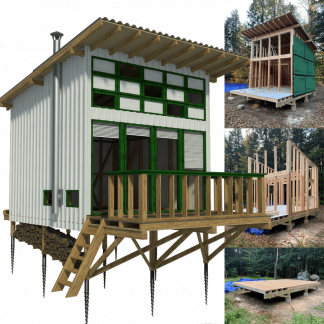

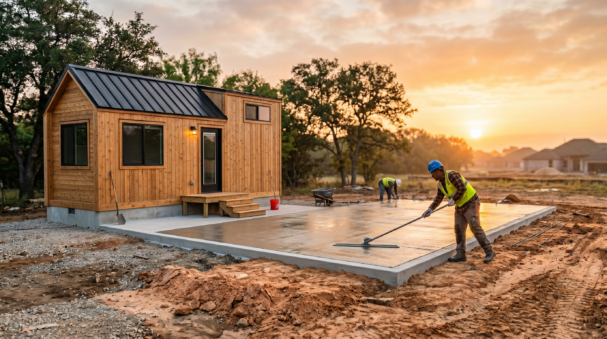
North Texas is a great place to build small. Tiny houses and ADUs add rentable space, guest suites, or office studios on tight lots—and they do it quickly. But the same conditions that make DFW boom also punish concrete: expansive clays swell and shrink with moisture, summer heat speeds set time, and sudden storm bursts reveal every grading mistake. For developers and owners, durable results come from a few disciplined decisions made early: read the site honestly, choose the right foundation for the soil and program, move water away from every edge, and pour only after the subgrade and utilities are truly ready.
DFW soils, weather, and what they mean for design
Across much of Dallas–Fort Worth, clay soils expand as they gain moisture and contract as they dry. That seasonal movement can curl slabs, tilt piers, and pop joints if the base is weak or drainage is sloppy. Heat adds a second pressure: high temperatures shorten finishing windows and increase plastic shrinkage cracking when curing is an afterthought. Finally, urban infill sites concentrate constraints—tight side yards, zero‑lot lines, and utility conflicts—so the sequencing of foundation, flatwork, and trades matters as much as the specs themselves. None of this argues for overbuilding; it argues for consistent fundamentals and project‑specific engineering.
Reading and prepping the ground
Start with water, because water is the root of most slab problems. Think in three layers: surface drainage, subgrade, and base. Surface drainage should pull water off the footprint and away from edges, never toward them. Subgrade in clay needs moisture conditioning so density is uniform—patchy compaction is what telegraphs as cracks later. The base should be a well‑graded, compacted aggregate that drains and resists pumping under wheels and foot traffic. On many sites, a great concrete job fails simply because the ground beneath it was rushed.
Quick site prep checklist (developer/owner friendly)
- Strip organics and soft spots; proof‑roll to find pumping areas and undercut as needed.
- Moisture‑condition clay subgrades and compact to a uniform density; stabilize with lime or cement where tests justify it.
- Place and compact a granular base suited to the load: more for drives/approaches, less for walks and ramps.
- Rough‑in, inspect, and backfill underground utilities before you form any slab, walk, or drive—then re‑compact trench zones under future concrete.
Choosing a foundation that fits small footprints
In DFW, two families cover most small homes and ADUs: slab‑on‑grade (often post‑tensioned) and pier‑and‑beam/grade‑beam hybrids. Slab‑on‑grade wins for schedule, flat interior transitions, and cost control. Post‑tensioning adds precompression that helps resist differential soil movement; a robust under‑slab vapor retarder (taped and protected) keeps interior flooring stable. Pier‑and‑beam decouples the structure from the soil’s seasonal gymnastics and simplifies underfloor mechanicals; properly engineered pier depths reach competent bearing and grade beams tie the system together. The right choice depends on the geotechnical report, program needs (e.g., underfloor access), flood risk, and how confidently you can control site drainage.
Foundation decision cues you can trust
- Choose slab‑on‑grade when a flat, continuous floor and fast schedule are priorities, your drainage plan is clear, and engineering supports a post‑tensioned or well‑reinforced design with correct beam layout and isolation at penetrations.
- Choose piers with grade beams when soils show high swell potential, the site sees periodic standing water, or future serviceability under the structure matters; verify pier depth/spacing to competent strata, provide a ground vapor barrier in the crawl, and maintain positive perimeter drainage either way.
- In all cases, let the geotech and stamped plans set thicknesses, beam depths, reinforcement, and jointing—not rules of thumb.
Moisture control that pays for itself
Details at edges are where long‑term durability is won. Keep finished grade at least six inches below siding, then slope away from the structure. Gutters and downspouts should carry water several feet from the building or into properly sized underground drains; daylight those lines somewhere that won’t boomerang flow back at the slab. On slabs, treat the vapor retarder as part of the structure: seams taped, punctures patched, and reinforcement supported on chairs so it isn’t dragged. In hot months, plan a real curing strategy—wet cure or apply curing compound promptly—so the surface doesn’t dry faster than the interior. Joints are not afterthoughts; saw on time, to full depth, and keep exterior joints sealed where water can intrude.
Access and hardscape for small sites
Even when the home is tiny, the concrete around it takes full‑size loads. Driveways should be thick enough for the traffic they’ll actually see, not just what a checklist says. On solid base, four inches of concrete can work for passenger cars, but in weak soils or for heavier loads (delivery trucks, trailers) you’ll get better performance by increasing base depth and slab thickness to five or six inches and thickening edges on narrow drives. Walkways feel better at 42–48 inches clear than at the bare‑minimum 36, and a light broom finish provides traction without being abrasive. Where grades change at entries, a simple site‑cast ramp can solve access and durability together—as long as slopes shed water away from the threshold and landings are generous enough to pause comfortably. Utility pads for condensers, generators, and EV chargers should be level, reinforced, and protected with bollards wherever a bumper or trailer tongue could strike them.
Construction sequence that saves rework
A disciplined order of operations on infill lots keeps fresh concrete from becoming a staging area—and then a patch.
- Lock permits, soils testing, and engineering before forms arrive.
- Rough grade and complete utility trenching; inspect, backfill, and compact trench zones under future slabs and walks.
- Moisture‑condition and compact subgrade; place and compact base; verify elevations against benchmarks.
- Pour foundations or piers first; then set elevations for walks, ramps, and drives to hit door thresholds and drainage targets.
- Schedule flatwork after heavy trades won’t rut subgrade; protect green concrete from tracked equipment and tight turns.
- Don’t open to traffic—or stripe adjacent asphalt—until cure and strength targets are actually met.
Finishing and curing in Texas heat
Heat and wind shorten the finishing window, so plan crews and mixes accordingly. Early morning placements help. Wind breaks, fog sprays, or retarding admixtures can keep the surface workable long enough to achieve a clean broom without tearing. Mark control‑joint locations before the pour so saw cutting can start as soon as the concrete supports it without raveling. The goal is even moisture loss through the slab’s depth; that’s what limits plastic shrinkage cracking and surface dusting.
Maintenance that extends life and preserves curb appeal
Concrete is low‑maintenance, not no‑maintenance. A light, regular routine prevents small flaws from compounding into trip hazards or water problems.
Owner/operator plan (once per season, plus after big storms)
- Walk the perimeter for ponding, eroded edges, or mulch creeping up against slab faces; correct grades before problems migrate indoors.
- Inspect joints; clean debris and renew sealant at exterior joints that channel water. Keep “incompressibles” (grit, pebbles) out so joints can do their job.
- Triage cracks: hairline shrinkage is usually cosmetic; monitor. Call a pro for cracks that widen, offset, or run through load points or corners.
- Protect surfaces that see staining or hot tire pickup; avoid harsh de‑icers that can scale or spall finishes. Resurface only when the base is sound; replace panels that have settled or rock under load.
When a professional crew changes the outcome
On paper, concrete is simple. On real DFW jobsites, the best outcomes come from people who treat subgrade preparation, drainage, reinforcement, weather, and sequencing as a single system. A seasoned local contractor reads the soils report and translates it into practical decisions—beam depths that match actual loads, post‑tensioning that resists seasonal movement, joint layouts that reflect real traffic paths, and curing plans that survive August. They also coordinate inspections and cylinder breaks so you open to foot and vehicle traffic when the slab is ready, not just when the calendar says it’s time.
Putting it all together
If you’re developing a backyard ADU in Arlington, tucking a studio into a tight Dallas side yard, or building a guest cottage on a Fort Worth clay shelf, the recipe doesn’t change much: drain the site, stabilize what moves, pick the foundation for the soil and program, pour only when the base and utilities are truly ready, and protect the cure. Do those things, and you’ll spend less time repairing edges, grinding lips, and fielding callbacks—and more time handing over keys.
For readers in the Dallas–Fort Worth area who prefer a single point of accountability—from subgrade and foundations to walks, ramps, and drive approaches—consider partnering with a local team that knows DFW soils, traffic patterns, and weather windows. For that, talk with Colt Concrete & Asphalt: https://coltconcrete.com/