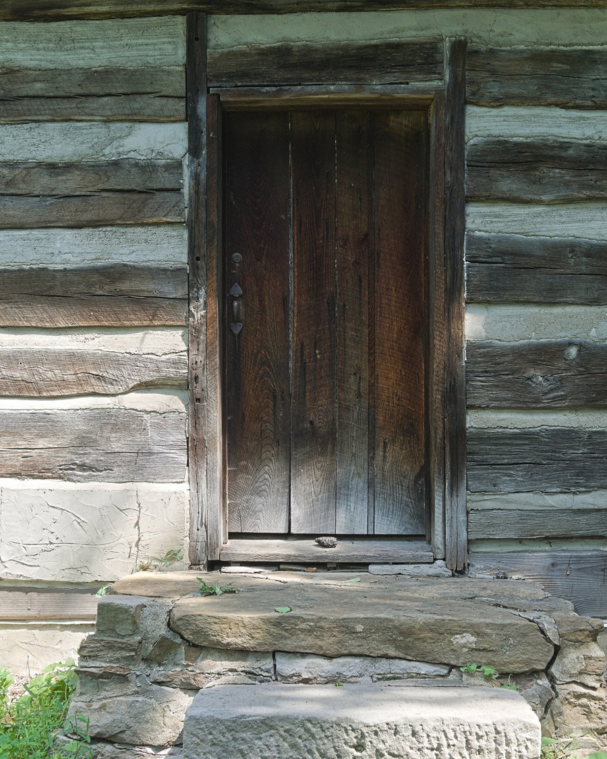
Short answer: the lock on an empty cabin fails from weather and neglect long before anyone tries to force it. Corrosion at the latch, a strike plate screwed into trim instead of framing, and a door that has swollen out of alignment account for most of what people find when they come back in spring. Specify for the climate and the frame, not for the burglar.
A cabin that sits empty from October to May is a different security problem from a house someone lives in. Nobody notices the sticking latch, nobody oils anything, and nobody is around to hear the door being worked on. The hardware has to survive on its own.
After building the thing yourself, the door is usually the last decision and the one made fastest. It deserves twenty minutes.
Corrosion is the actual adversary
Unheated buildings breathe. Warm days drive moisture into a cold structure, it condenses on the coldest metal in the room, and the coldest metal is usually the lock body.
This is why cabin locks seize. It is not rain and it is not the sea, it is the daily temperature swing inside an unheated building with a door that faces weather on one side and dead air on the other.
Two choices matter more than everything else combined:
- Stainless or solid brass internals, not plated pot metal. Plating fails at the edges, then the base metal blooms and the mechanism binds.
- A cylinder rated for exterior exposure. Cheap cylinders are the first thing to freeze, and a seized cylinder on an empty cabin means either a locksmith call or a drilled door.
If the building sits near salt water, go stainless and stop debating. Everything else will be a rust stain within three seasons.
The strike plate decides whether the door holds
A lock is only as strong as what the bolt lands in. Most doors that get kicked open do not have a broken lock, they have a strike plate that pulled straight out of the door casing.
Standard strike plates ship with three-quarter inch screws that bite into trim. Trim is nailed to the frame. Kick it and the whole assembly leaves together.
The fix costs almost nothing:
- Replace the strike screws with 3-inch screws that reach into the structural stud behind the jamb.
- Use a box strike, so the bolt is captured on all four sides instead of resting in a stamped hole.
- Check the bolt throws fully home. On a swollen door it often does not, which means the deadbolt is decorative.
Do this and a hollow-sounding door becomes genuinely hard to force, for the price of a handful of screws.
Deadbolt or nothing
A latch bolt is a convenience device. It is spring-loaded, it retracts under pressure and it can be carded open. For a building nobody visits for six months, the deadbolt is the lock and everything else is a handle.
Look for a bolt that throws a full inch, a hardened insert against sawing, and a solid body. Grade 1, the heaviest duty rating, is rare in the wider market: in an analysis of 15,447 door hardware SKUs it made up only 7.2% of the catalogue, so it will not be what a big-box display offers by default.
Cost is not the obstacle people expect. In that same catalogue, commercial deadbolts carried a median price of $89, well inside the range of what a builder spends on hinges without thinking about it.
If the cabin has a back door or a workshop entry, key them alike from the start. Nothing turns into a mess faster than four buildings on a site with four unrelated keys and no record of which is which.
Securing an off-grid build with no power at the door
Everything electronic assumes a power source and a network. Off grid you have neither, so the security has to be mechanical or it has to be independently powered, and both have limits worth knowing before you buy.
Battery keypads are the usual first thought. They work, with two caveats: cold destroys battery life, and a dead keypad on a remote building is a locked-out owner. Any keypad on a cabin needs a mechanical key override, no exceptions.
The mechanical alternatives are unglamorous and reliable:
- A quality single-cylinder deadbolt with a reinforced strike, as above.
- Hinge-side security. Exterior doors on cabins are often outswing to shed water, which puts the hinge pins outside. Use non-removable pins or security studs, otherwise the door lifts off with a screwdriver regardless of the lock.
- A barrel bolt or drop bar on the inside of a door you leave from another exit, for the months the building is empty.
What to check on the way out for the season
- Bolt throws fully home with the door closed, not just with it open
- Strike screws reach the framing
- Hinge pins secured on any outswing door
- Cylinder lubricated with a dry graphite or PTFE product, never oil, which collects dust and gums up
- One key with a neighbour or caretaker, and a record of what it opens
Frequently asked questions
What kind of lock is best for an unheated cabin? A Grade 1 or Grade 2 deadbolt with stainless or solid brass internals and an exterior-rated cylinder. The failure mode in an unheated building is corrosion from condensation, not forced entry, so material choice matters more than the lock’s rating on paper.
Why do cabin locks seize over winter? Temperature swings in an unheated building drive condensation onto the coldest metal, which is usually the lock body and cylinder. Plated finishes fail at the edges first, then the base metal corrodes and the mechanism binds.
Are keypad locks a good idea off grid? Only with a mechanical key override. Cold reduces battery life sharply, and a flat battery on a remote building leaves you outside with no fallback.
How do I stop a door being kicked in? Replace the strike plate screws with 3-inch screws that reach the stud behind the jamb, and fit a box strike. Most forced entries break the frame, not the lock.