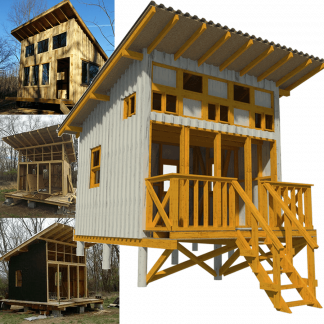

For a tiny home or off-grid build, the roof carries more than one job. It keeps weather out, but it also doubles as a water collector. Every drop a builder catches off the roof is one less gallon hauled in by truck or pumped from a well. Done right, a properly designed metal roof feeds a 500 to 1,500 gallon cistern through a Carolina rainy season with very little ongoing maintenance. Done wrong, the same roof contaminates the cistern with zinc, lead, or solvent residue and quietly compromises the household’s water supply.
After more than a century of roofing Carolina homes, the same questions show up from off-grid builders again and again. Most of the answers come back to four decisions made before the roof even goes up.
Why Metal Is the Right Roof for Rainwater Catchment
The American Rainwater Catchment Systems Association and the EPA’s rainwater harvesting guidance both list metal roofs as the preferred surface for potable collection. The reasons are straightforward.
Asphalt shingles shed petroleum residue and granules into runoff. Wood shake is porous and feeds biological growth. Clay tile is heavier, more fragile under hail, and more expensive to repair at the small scale a tiny home roof requires. A standing-seam metal roof is smooth, flushes clean in the first minute of a storm, and lasts 40 to 70 years with minimal degradation.
The catch is that not all metal roofs are safe for potable water. The decision narrows further once potability is on the table.
Choosing the Metal: Three Options, One Recommendation
There are three common metal roof types for tiny homes and small off-grid structures.
Galvalume steel is the standard recommendation for rainwater catchment. The coating is a 55% aluminum, 43.5% zinc, and 1.5% silicon alloy, applied per ASTM A792. It sheds water cleanly, resists corrosion well in Carolina’s humid air, and the alloy is stable enough that runoff stays within drinking-water safety limits after a properly sized first flush.
Galvanized steel uses a pure zinc coating per ASTM A653. It’s cheaper than galvalume but releases more zinc into runoff during the first few years of weathering. For non-potable uses (garden irrigation, livestock, laundry greywater) it’s fine. For drinking water, galvalume is the safer baseline.
Aluminum is the most expensive option per square foot but lasts longest in coastal or high-humidity environments. It’s the right choice for builds within 10 miles of saltwater. Runoff from bare aluminum is potable-safe with standard filtration.
The Coating Decision That Trips Up Most DIY Builders
The metal alloy is only half of the potability question. The factory-applied paint or coating is the other half.
Standard SMP (silicone-modified polyester) and Kynar 500 (PVDF) coatings are widely used on residential metal roofing. Both are inert once cured and safe for rainwater catchment provided the coating is intact. The problem appears with cheaper finishes. Some powder coats and a few imported coatings can leach trace solvents, chromates, or VOCs into runoff during the first one to two years of weathering.
When a roof is destined for potable catchment, the simplest check is to ask the supplier for an NSF-61 certification or equivalent letter confirming the coating is rated for drinking-water contact. A reputable manufacturer provides one in writing. A supplier who can’t or won’t is selling something other than what the catchment system needs.
Roof Geometry: Slope, Gutters, and the First Flush
A metal roof can be perfectly chosen and still produce poor catchment if the geometry is wrong.
Most rainwater systems work best at a roof slope between 3:12 and 6:12. Lower than 3:12 and water pools long enough to pick up dust and pollen. Steeper than 6:12 and the first flush moves too fast for sediment to drop out in the diverter. Tiny home shed roofs at the steep end (often 4:12 to 5:12 to fit road-legal height limits) tend to fall right inside the sweet spot.
Gutter sizing follows from the roof area and the regional rainfall rate. For Carolina, a 5-inch K-style gutter feeding a 3-inch downspout handles up to about 300 square feet of catchment area at peak storm rates. Larger roofs need oversized gutters or a second downspout. Undersized gutters cause overflow that loses the highest-flow part of a storm (where most clean rainfall sits) and feeds the cistern with the dirtier tail end instead.
A first-flush diverter sits between the downspout and the cistern. Its job is to capture the first 5 to 10 gallons of every storm, the part that washes accumulated pollen, dust, and bird debris off the roof, and divert it before it reaches the drinking-water tank. ARCSA recommends sizing the diverter at one gallon per 100 square feet of catchment area. For a typical 250-square-foot tiny home roof, a 2.5 gallon diverter is the floor.
The Mistakes That Most Often Show Up
Four mistakes recur across off-grid builds.
Sealing the roof seams with the wrong sealant. Standard butyl tape and silicone sealants can leach plasticizers into runoff during their cure period. Use a sealant rated for potable-water contact (manufacturer documentation should specifically confirm this).
Skipping the first-flush diverter. The cistern stays cleaner for years longer when the first gallons of every storm are diverted to a non-potable line. Without one, sediment accumulates in the cistern and the filter cartridges downstream wear out two to four times faster.
Undersized cistern overflow. During a major storm event the cistern fills and the overflow needs to handle the same flow rate the gutter does. An undersized overflow backs water up into the gutter and pushes contaminated water past the diverter.
Forgetting the cistern itself needs the same standards. A potable-rated roof feeding a polyethylene tank that’s not food-grade is a half-finished job. Look for NSF-61 stamped tanks specifically.
When to Bring in a Professional
Most of the roof side of a rainwater catchment build is well within DIY range if the builder follows manufacturer instructions and treats the documentation seriously. Where a professional roofer earns the call-out fee is on three specific items: confirming the coating and metal alloy match the intended potable use, sealing the seams and flashings with the right products, and validating that the gutter and overflow are sized correctly for the roof’s catchment area.
For a tiny home or off-grid build where the roof is doubling as a water collector, the right time to involve an experienced roofing contractor is during the design phase, not after the roof is on. A 30-minute conversation before the metal panels are ordered saves the cost and headache of a re-roof six months in when the water test comes back outside drinking-water standards.