Quick Answer
Resilient surfaces for cabins, tiny dwellings, and off-grid retreats combine sealed finishes with vapour-resistant subfloors. Resin coatings, sheet vinyl, porcelain tile, and rigid core planks handle moisture cycling, freeze-thaw exposure, and intermittent heating reliably. Match the product to your substrate type, occupancy pattern, and ventilation strategy to achieve waterproof floors that last for decades without warping, mould growth, or seam failure.
Introduction
Building in remote settings forces a different conversation about surface selection. Compact retreats sit empty for stretches, then absorb sudden humidity loads from cookstoves, breath, and damp gear. Substrates expand and contract through wide temperature swings, while many sites lack the mechanical airflow that flushes airborne water from urban builds. Ordinary finishes cup, delaminate, or harbour mildew within a handful of seasons under these loads.
Skilled installers working in northern climates apply substrate testing, moisture management protocols, and resin chemistry standards drawn from industrial practice, then adapt them for residential comfort. Specialized epoxy flooring terrace systems become relevant here because the coating logic that protects exterior decks also stabilizes interiors against spills, condensation, and seasonal swings.
Why Moisture Defines Resilient Cabin Surfaces
Compact and rural dwellings behave very differently from suburban homes. Their thermal envelopes are smaller, occupancy is irregular, and exposure to ground dampness, snowmelt, and condensation is amplified. Any chosen surface must perform from a frozen interior at minus twenty degrees Celsius to a humid summer cottage warmed rapidly by a wood stove.
Building Science Behind Intermittent Use
When a structure sits unheated for weeks, the slab or joist assembly equalizes with outdoor humidity. Once occupants arrive and warm the space, the vapour drive reverses, pushing airborne water toward cooler materials. Without a continuous capillary break beneath the finish, dampness collects at the substrate interface and degrades adhesives, fasteners, and timber elements.
Subfloor Conditions in Off-Grid Builds
Rural sites rarely include slab-on-grade construction with modern dimple membranes. Many rely on pier foundations, exposing joists to ventilated crawl space air saturated with ground vapour. The outcome is asymmetric loading, where the underside stays damp while the top dries quickly during occupancy.
Three priorities define resilient cabin flooring ideas in these settings:
- Dimensional stability through seasonal temperature cycling.
- Seam integrity at perimeters, thresholds, and plumbing penetrations.
- Permeability matched to the assembly’s drying direction.
Ignoring any factor shortens service life regardless of how premium the visible layer appears.
Material Choices and Site-Ready Installation Standards
Choosing a surface for a remote build means weighing chemistry, substrate compatibility, and labour realities. The categories below cover four systems that perform reliably across seasonal cottages, tiny homes, and rural retreats when installed to recognized specifications.
Comparing Performance Across Surface Categories
| Material | Moisture Rating | Service Life | Substrate Needs | Best Application |
| Resin Coatings | Fully sealed | 15 to 25 years | Sound concrete, low RH | Slab-on-grade builds |
| Sheet Vinyl (heat-welded) | Waterproof seams | 12 to 20 years | Smooth plywood or slab | Tiny homes, washrooms |
| Porcelain Tile | Impervious body | 40 plus years | Rigid, deflection under L/720 | Heated slab interiors |
| SPC Core Planks | Surface sealed | 10 to 18 years | Levelled subfloor | Pier-supported retreats |
Resin Systems and Tile for Demanding Sites
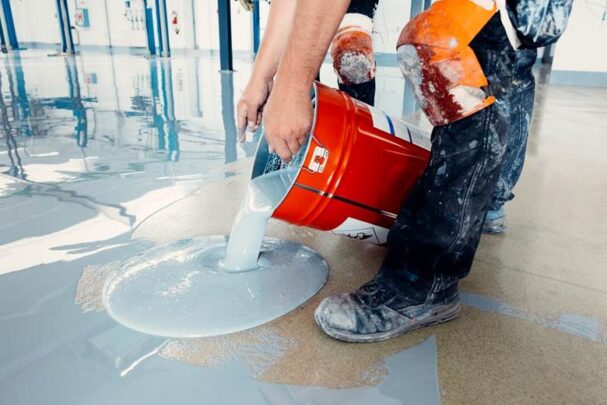
Among the best flooring for log cabins, resin-based coatings handle freeze-thaw cycling exceptionally well because they bond monolithically with the slab, eliminating gaps where water migrates.
Modern epoxy flooring for cabins includes flexible aliphatic topcoats that resist UV yellowing through south-facing windows, while polyaspartic blends cure at temperatures as low as minus five degrees Celsius. Porcelain remains unmatched for thermal mass pairings with hydronic radiant systems, though it demands rigorous deflection control on joist assemblies.
Watch for these site faults that compromise long-term performance:
- Skipping primer coats on porous concrete substrates.
- Insufficient roller back pressure on glue-down vinyl seams.
- Tile underlayment screwed instead of bonded with modified thinset.
Specifying correctly is half the work. Disciplined execution determines whether the assembly meets its rated service life.
Long-Term Care and Climate Ready Upgrades
Lasting value in rural construction comes from anticipating how a surface ages under repeated stress cycles. Care routines, climate adaptation, and serviceability decisions made at the specification stage shape whether the asset remains quiet or becomes a recurring expense.
Care Routines That Extend Service Life
Even sealed assemblies benefit from disciplined upkeep. Resin coatings should be inspected yearly for hairline fractures at control joints, particularly where seasonal slab movement concentrates stress. Resilient products require pH-neutral cleaning agents to preserve the wear layer, since alkaline degreasers strip protective topcoats within several washes. Grout lines need penetrating sealer reapplication roughly every three years in busy zones.
Adapting to Climate Shifts and Changing Use
Seasonal weather is intensifying across northern regions, bringing wetter shoulder months and faster freeze-thaw transitions. Specifying systems with proven elasticity, such as polyaspartic topcoats rated for substrate movement, hedges against this volatility. The same logic applies outdoors. A properly engineered epoxy for terrace zone creates a continuous protective envelope from interior to deck, reducing thermal bridging at thresholds.
Three habits separate durable installations from premature failures:
- Document moisture readings and batch numbers at install.
- Schedule mid-life recoats before wear reaches the base layer.
- Maintain perimeter caulk lines yearly around plumbing and doors.
When evaluating waterproof floors for compact or rural dwellings, treat the project as a coordinated system rather than a single product, and the result will reward your planning across generations of use.
Key Takeaways for Durable Remote Builds
Resilient flooring in cabins and compact dwellings depends on matching surface chemistry to substrate behaviour, occupancy rhythm, and regional climate loads. Resin systems, porcelain, sheet vinyl, and SPC core planks each solve specific problems when installed to professional standards.
Document moisture readings, respect acclimatization windows, and commit to scheduled maintenance. Sound small house flooring ideas always treat the assembly as a system rather than a single product, delivering decades of predictable performance under demanding seasonal conditions.